NEW YORK – Cadillac introduces technology and design enhancements to the SRX luxury crossover SUV this week at the New York International Auto Show. Among the new features for 2013 is CUE, the in-vehicle user experience that incorporates touch-screen controls similar to the most popular mobile devices.
The 2013 SRX’s enhanced technology also contributes to safety, with Cadillac’s new Driver Awareness and Driver Assist technology packages. Their features include Rear Cross Traffic Alert, Cadillac’s Safety Alert Seat technology, Automatic Front and Rear Braking, Adaptive Cruise Control and more, using radar and other technologies to help avoid collisions.
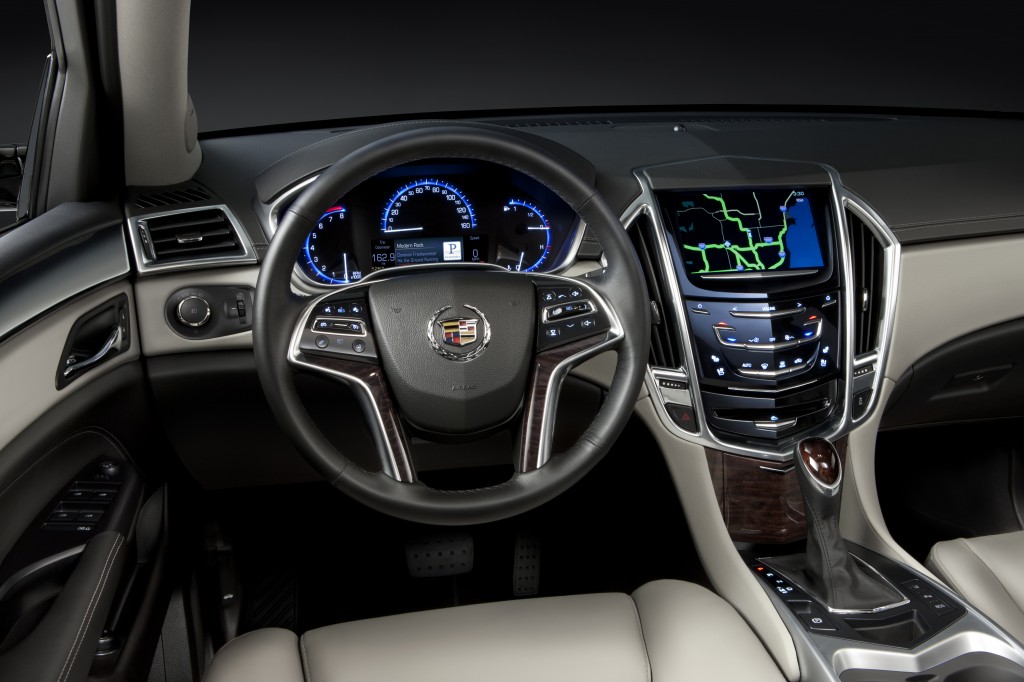
2013 Cadillac SRX courtesy Cadillac
Interior and exterior design updates further distinguish the 2013 SRX, while active noise cancelation technology helps provide a quieter driving experience. It goes on sale this fall.
“The 2013 SRX illustrates the Cadillac philosophy of never leaving well enough alone,” said Don Butler, vice president of marketing for Cadillac. “The enhancements for the SRX – including CUE – are examples of how we’re developing advanced technologies and pushing them consistently through the Cadillac portfolio. They are also some of the key elements of the all-new XTS luxury sedan and ATS compact sedan, which will expand the Cadillac portfolio this summer.”
Since its redesign in 2009, the SRX has established a strong visual signature for Cadillac in the luxury crossover segment. The 2013 SRX refines that appearance with a new design for the front upper and lower grilles that conveys greater depth and the brand’s attention to detail. The front fender vents are new and incorporate LED light pipes.
Three new exterior colors are offered: Evolution Green Metallic, Glacier Blue Metallic and Silver Coast Metallic. Also new is the SRX’s range of 20-inch wheel designs, including new chrome and polished aluminum wheels for the Performance and Premium Collections – the top two option packages.
The SRX is offered in FWD and Advanced AWD models, each powered by a 3.6L Direct Injection V-6 that was added for 2012. It is rated an SAE-certified 308 horsepower (230 kW) and 265 lb.-ft. of torque (358 Nm).
Cadillac CUE
Cadillac CUE (Cadillac User Experience) is standard on the 2013 SRX. It is the brand’s new design and technical breakthrough for intuitive in-vehicle control and connectivity.
CUE pairs entertainment and information data from up to 10 Bluetooth-enabled mobile devices, USBs, SD cards and MP3 players with a vehicle infotainment system that reduces complexity through customized information, voice commands and fewer buttons and larger icons. The comprehensive, in-vehicle experience is designed to be unique for each consumer, from the “simple user” to the fully connected “super user.”
The heart of CUE is the vibrant, eight-inch LCD multi-touch sensitive screen – with proximity sensing and haptic feedback – that is seamlessly integrated in the top of the central instrument panel. It displays CUE’s home page, which resembles a smart phone’s screen, with large, easy-to-target icons that execute commands. Capacitive technology on the screen and faceplate enables consumers to use the same “swipe,” “pinch” or “spread” gestures common to most popular smartphones and tablets.
A motorized faceplate for the system reveals a concealed storage area for smartphones or other mobile devices and includes an illuminated USB port.
Interior enhancements
CUE is the foundation for the 2013 SRX’s enhanced driving experience and is complemented with additional features and design refinements:
- Standard HD radio
- Bluetooth audio streaming is available for all collections
- A USB port in the storage bin behind the CUE faceplate
- The center console now features two additional USB ports, an SD card slot auxiliary input jack and 12-volt power outlet
- New headphone and remote design for the rear-seat entertainment system, which also includes a rear USB port and SD card slot
- New shift knob design
- New steering wheel design
- New instrument cluster with new driver information center for CUE integration.
Active noise cancelation is new for 2013 and helps create a quieter driving experience. The system uses microphones to detect ambient noise, the frequencies of which are processed by a computer that directs counteracting sound waves through the audio system to tailor the sound quality and character inside the cabin.
A new Light Titanium interior color combination is added and matched with a new Raven Sapele wood color accent.
Popular interior features returning for 2013 include keyless access, ambient lighting, power-adjustable pedals, heated front and rear outboard seats, heated steering wheel and the UltraView power sunroof.
‘Control and alert’ safety features
SRX is the latest to incorporate Cadillac’s “control and alert” strategy that employs advanced technologies – including radar, cameras and ultrasonic sensors – to help prevent crashes. The safety features are part of Cadillac’s new Driver Awareness and Driver Assist technology packages.
The advanced technologies bolster driver vision and awareness of road hazards, intervening to help the driver avert potential collisions. In some cases, Cadillac’s crash-avoidance systems will act without the driver, such as automatic braking, which activates based on information indicating potential hazards.
Radar-based adaptive cruise control and front and rear automatic braking are available. Front and rear automatic braking relies on short-range radar technology and ultrasonic sensors to help the driver prevent front and rear low-speed collisions via a progression of alerts that extend to complete braking, if necessary. Additional advanced safety features offered on the 2013 SRX’s Driver Awareness and Driver Assist packages include:
- Forward Collision Alert
- Lane Departure Warning
- Rear Vision Camera With Dynamic Guidelines
- Safety Alert Seat.
Side blind zone alert and rear cross traffic alert are standard. Each uses radar to detect vehicles that may be out of the driver’s vision, providing visual alerts in the outside mirrors and, in the case of rear cross traffic alert, audible warnings. StabiliTrak electronic stability control system with traction control, and four-wheel disc brakes with four-channel ABS are also standard, along with:
- Dual-stage frontal and side-impact driver and right-front passenger air bags.
- Head-curtain side-impact air bags.
- Rollover mitigation sensors.
- Front safety belt pretensioners and load limiters.
The SRX is also designed to meet European pedestrian protection standards, with the front bumper positioned for greater compatibility with car bumpers.