Cadillac XLR LH2 V8 Tuning – Tune 8A

Tune 8A commands 12.8:1 AFR from 1500-6700, where Tune 7A was at 12.5:1 AFR.  The VVT in 8A has some minor cleanup in an unused area.   The piston protection in 8A is at 8192; in 7A 6400 rpm.   7A was the ‘just advance the timing’ run, so 8A has 2 degrees less timing from 2300-5600 more or less, with -3 at 4200-4400.
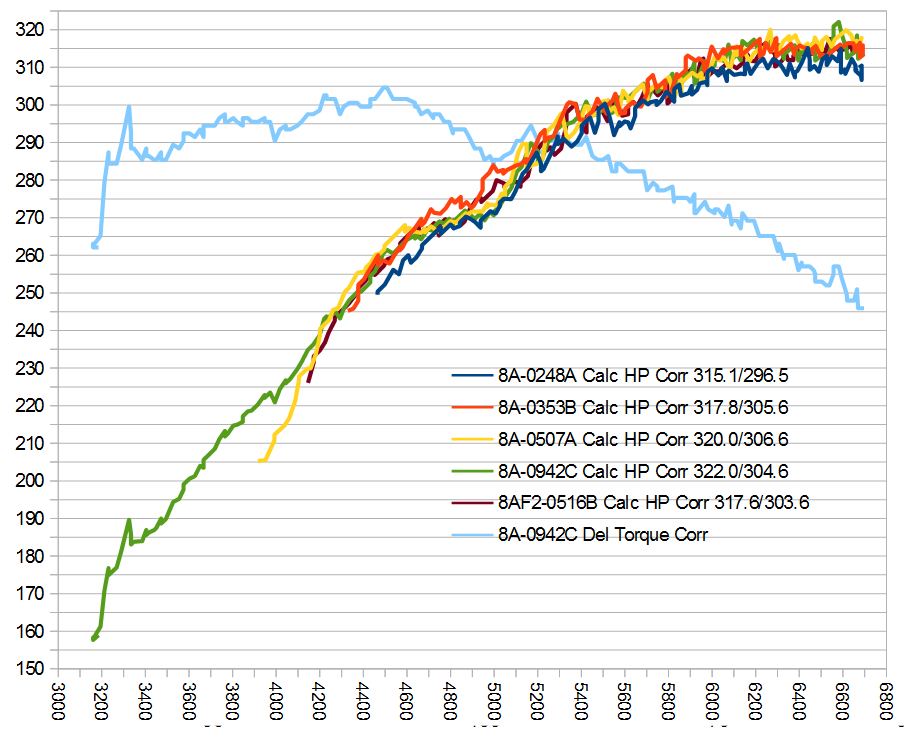
XLR Tune 8A all 5 runs calc

I ran 5 runs today to study run to run variance.  I have started not initiating the scan until ready to test, which avoided (randomly?) the scanner hang issue. The reference number for each test is the Tune (8A), the time the run starts in its scan (0942) and the test area used for the run (A, B, C).  Test area A data was uniformly hard to smooth for Virtual Dyno, so I will plan to exclude it and focus on B or C.

The runs on the graph above are all the same tune 8A.
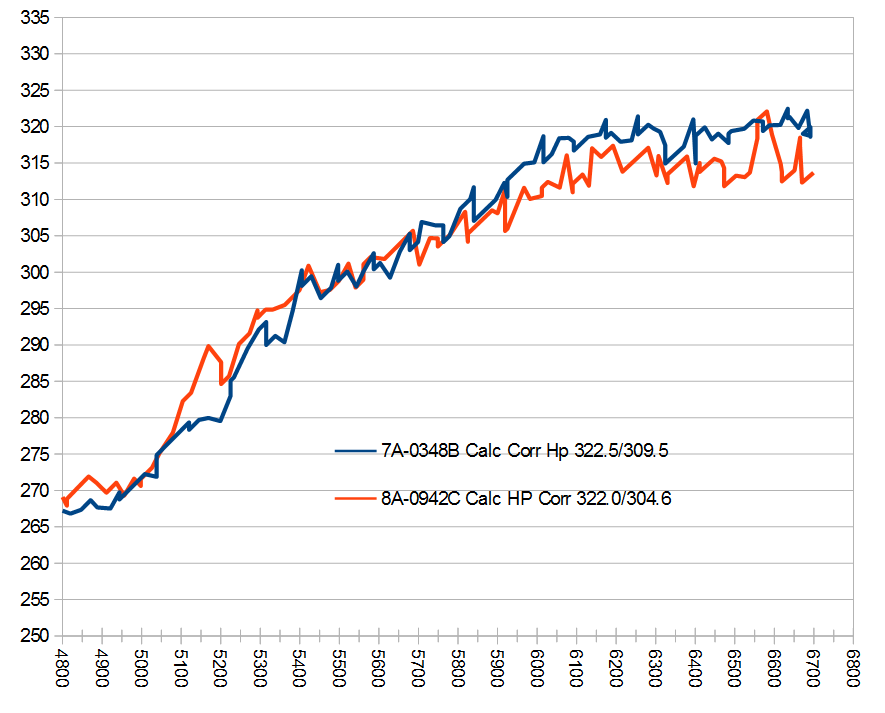
XLR Tune 8a to 7a calc hp comparison

This comparison of 7A, which was non-viable due to heavy KR, vs 8A-0942C.  Even with the main spark retard in 8A there is still some KR in that run, perhaps caused by IAT advance?
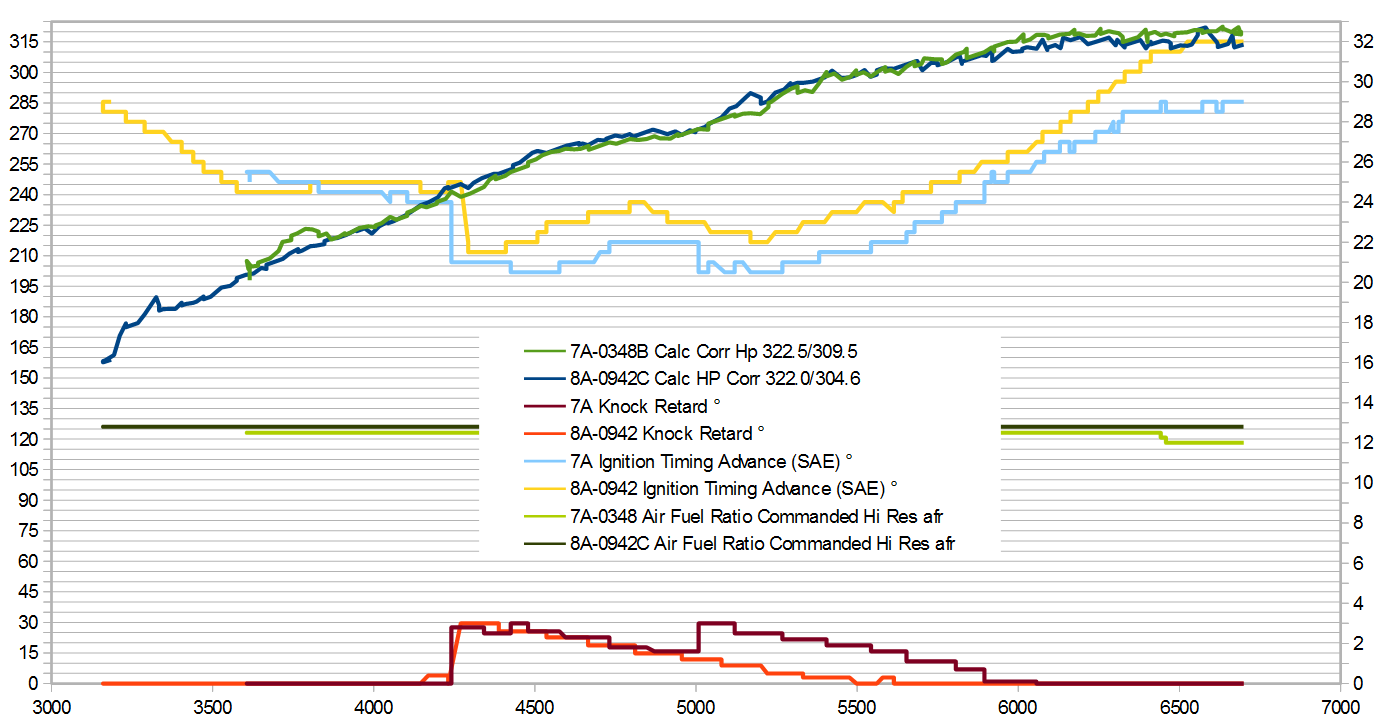
XLR Tune 8A comparison timing to 7A

8A is able to run more timing than 7A partially due to conditions, and due to avoiding some KR at 5000 RPM.  The max timing on 8A actually runs above MBT so I will reduce timing from 6500 RPM. One knock event causes 3 degrees of KR and the characteristic stair-step decay from 4250-5500 rpm.  My goal is to tune out any knock.

These show the raw calculated data, with no smoothing.  All 5 runs HP data, 1 run torque data for reference.  The hp/torque maximums are shown for each run, which is less valuable unsmoothed but provides a reference.
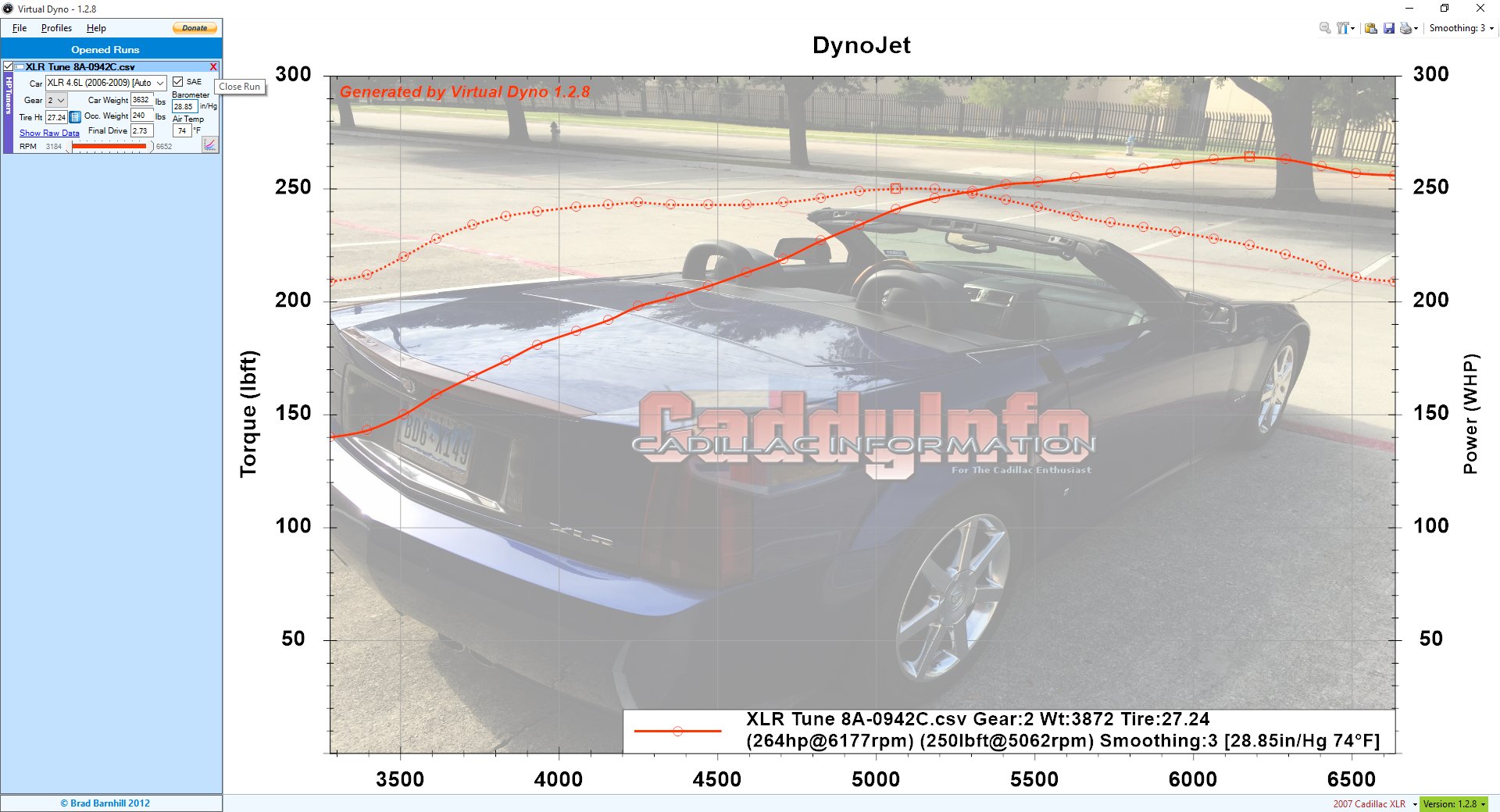
XLR 8A-0942C Virtual Dyno

This is the Virtual Dyno wheel hp / torque for the 8A-0942C.

Here is a comparison across viable runs with a Tune 7A run included
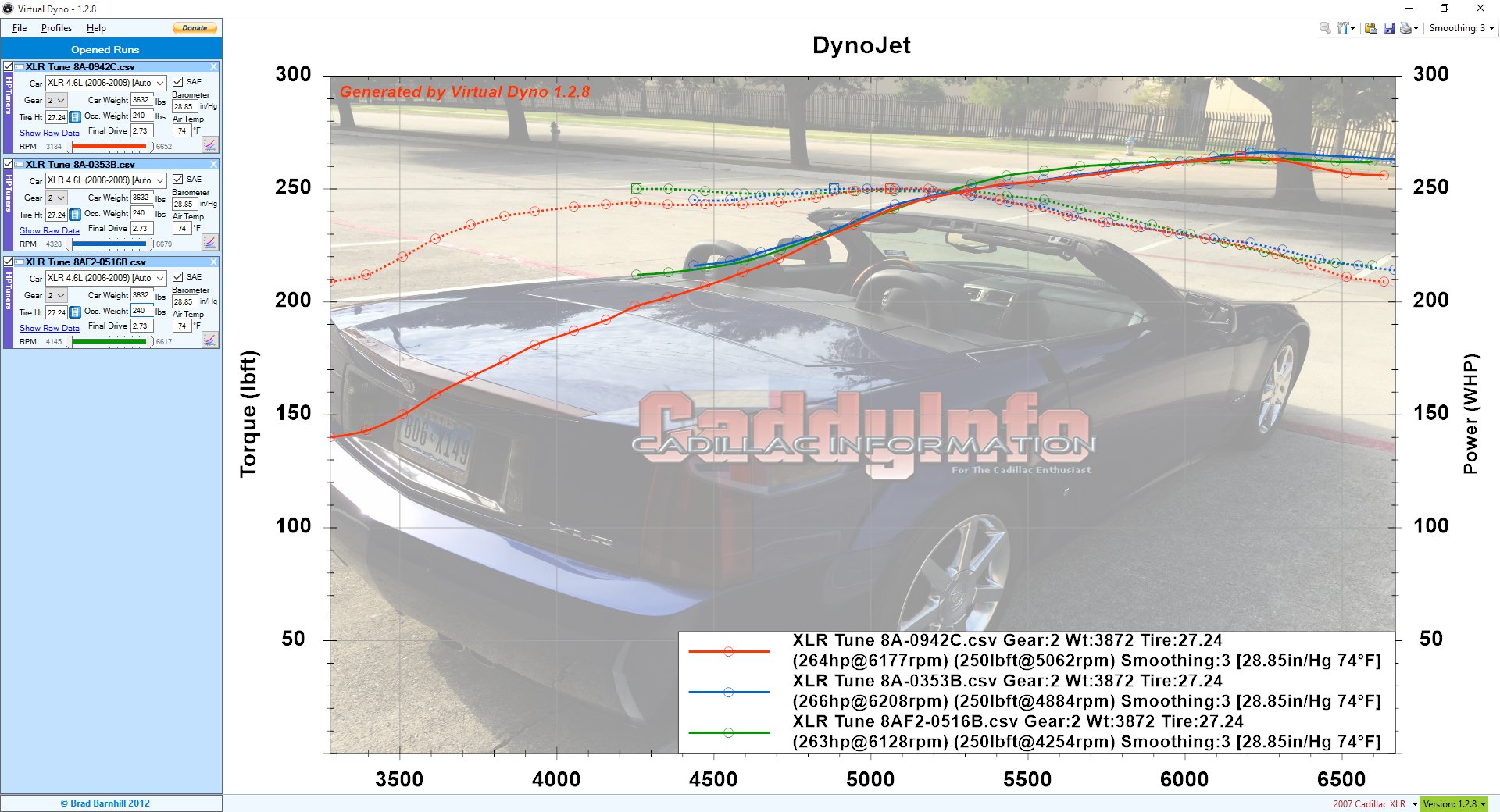
XLR Tune 8A 3 Viable Run Comparison

Given 7A and 8A are on different days they appear to be equivalent and I don’t see a tune delta in the Virtual Dyno plot.

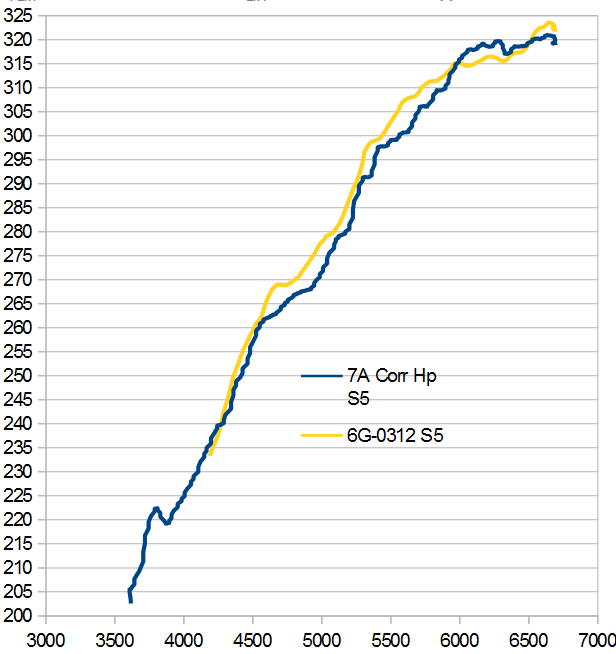
XLR Tune 8A comparison 7a Virtual Dyno


Cadillac XLR LH2 Tuning – Tune 7A Timing

Today’s test was to add 2 degrees of timing advance in the mid-range except in knock-sensitive areas, and up to 4 degrees near redline.  This builds the timing to be closer to the MBT table.

XLR Tune 7A-0348 Comparison to Tune 6G-0312

The result was more KR in the midrange, which is not good.  Overall today’s test came out as lower calculated HP/Torque than the prior 6G-0312 test except in the 6000-6400 range where it gained 5 hp.

XLR Tune 7A Weather Corr

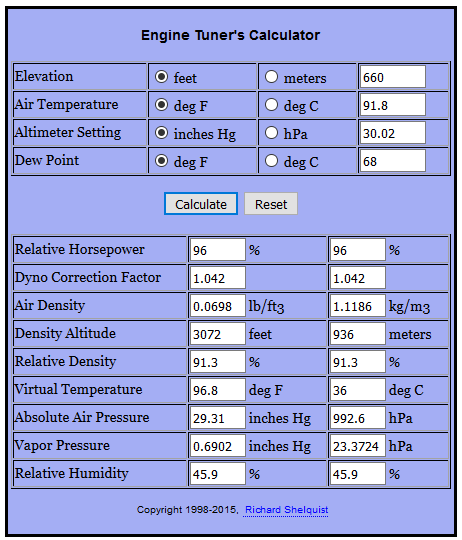
Weather correction data table https://wahiduddin.net/calc/calc_hp_dp.htm

XLR Tune 7a-0348 HpTuners

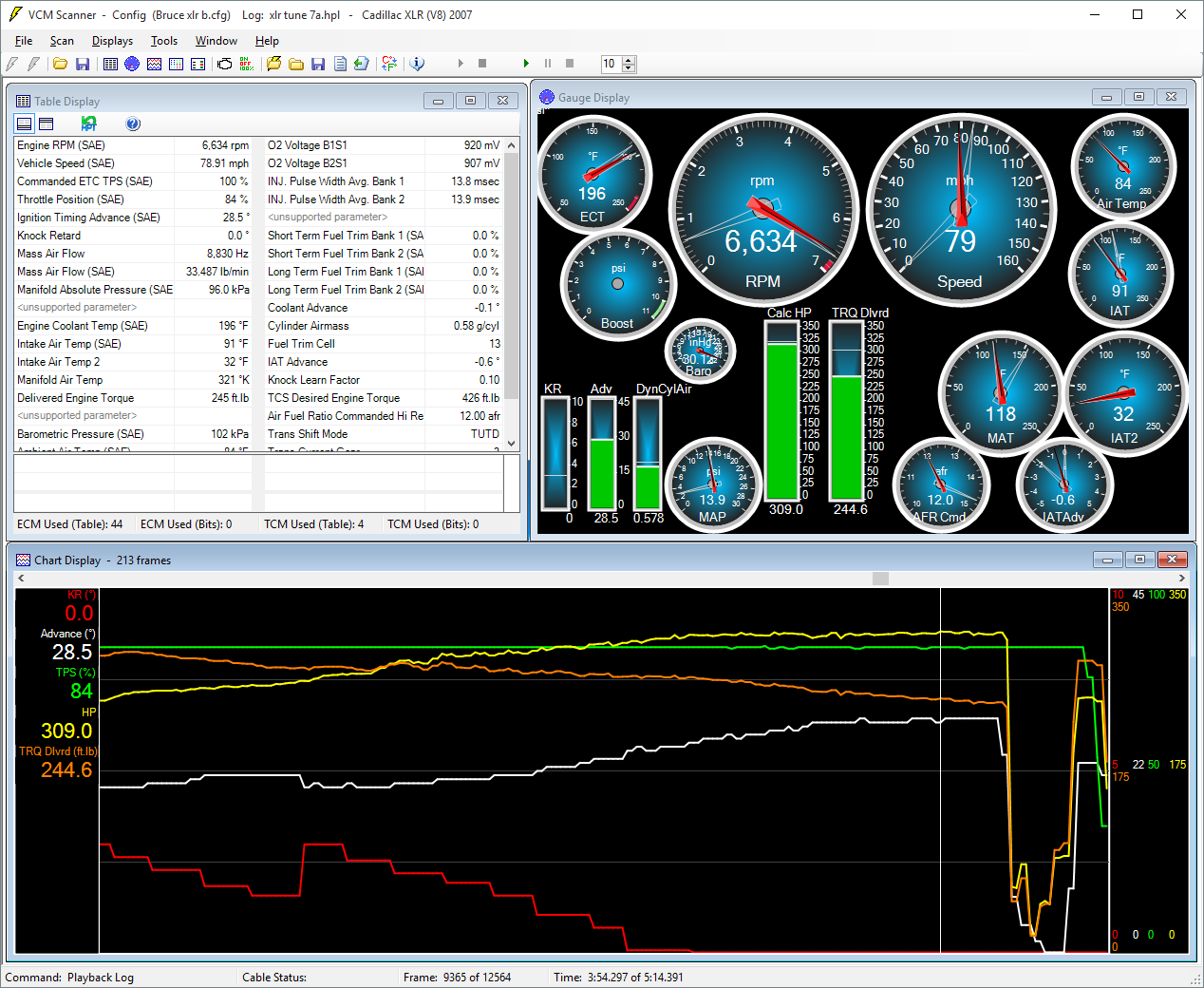
Uncorrected HPtuners output at peak HP.

Reviewing 7A, in a classic ‘Don’t do two things at once’ mistake I took the AFR 0.5 richer at 6400 rpm, so that could impact the tip-over in today’s run.  I will take that out, and look at the spark level desired at 6800 rpm.  I also plan to re-test AFR at 12.8:1 instead of current 12.5:1.  I tested that in Tune 2 but I want to recheck.

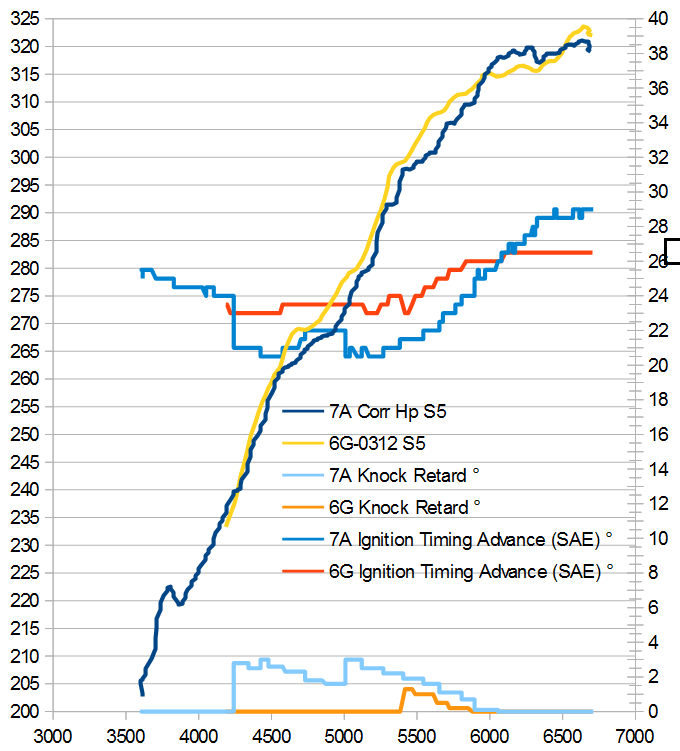
XLR Tune 7A-0348 to 6A-0312 Timing


This chart shows the LOSS of timing due to KR for 7A by increasing the timing, except above 6000 RPM.


Cadillac XLR LH2 Tuning – Tune 6G earlier VVT

Instead of running more 6F baselines I decided to retry the early intake VVT and late exhaust retard from Tune 6C along with the other current settings from 6F.  6C was a confusing test result, as it was intuitively an improvement to 6B but tested worse.  Because of the reset on Virtual Dyno, and method to correct for Humidity, and analysis that the 6B result was better than baseline for Tune 6B, (or any repetition since), I moved forward to 6G.

Compared to the Factory calibration, Tune 6G retards the intake and exhaust cams more earlier, from 4800 rpm – 5600 rpm (effecting 4400-5800) and above 6400 rpm.  The MAF is tuned for the Volant air intake.  The Top speed is adjusted to 186.  Piston protection is delayed from 6000 rpm to 8192 rpm. PE ramp in is adjusted from 0.1 to 1.0.  TUTD is adjusted to shift to the next higher gear at redline instead of holding for manual shift.  The engine cooling fans some on stronger earlier.

The scanner froze before test 6G-0203, but easily reset and the XLR didn’t tilt.

I did two runs for 6G, a practice I think I will return to as a way to understand run to run variation.

XLR Tune 6G Comparison of Both Runs

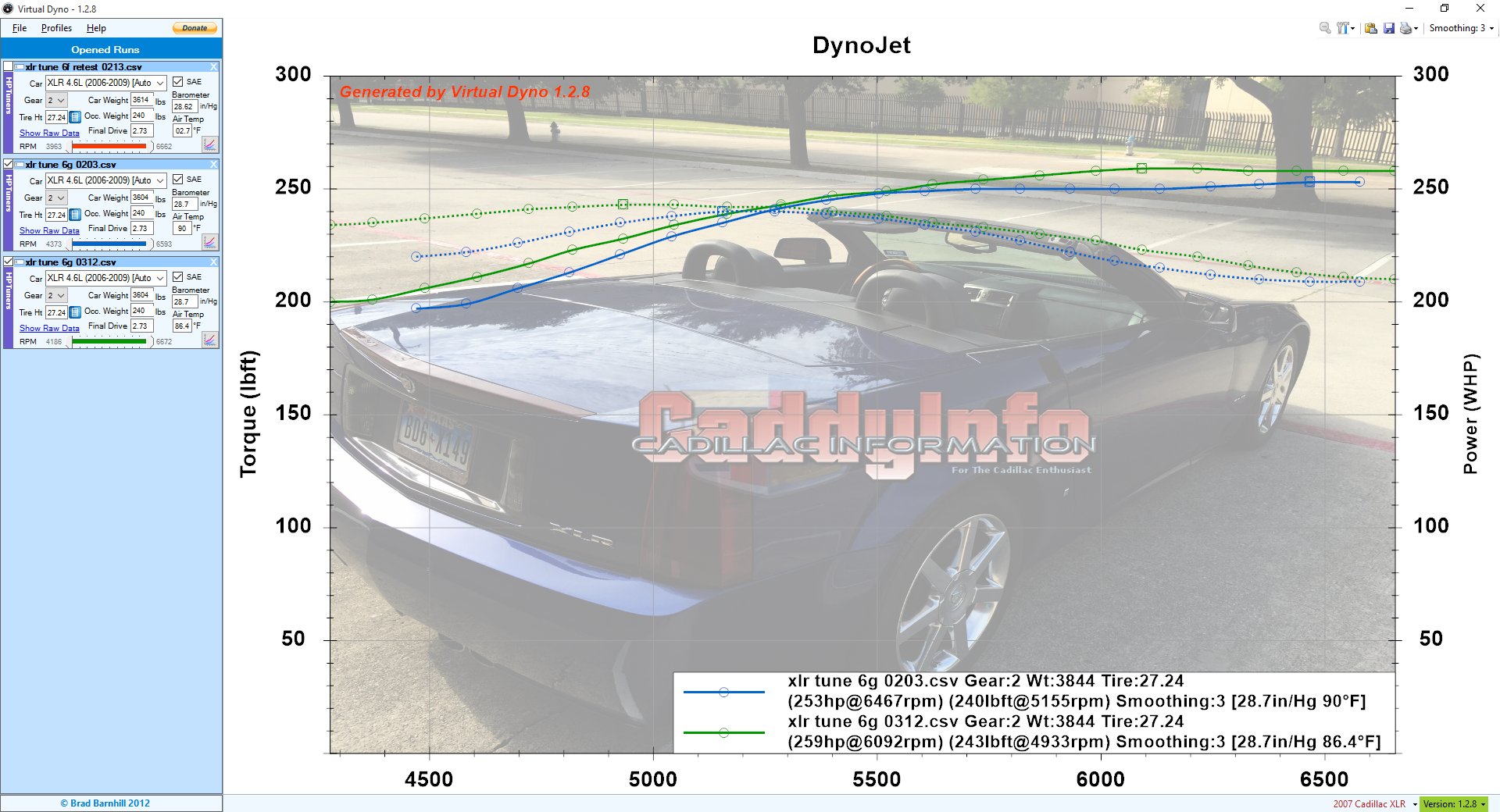
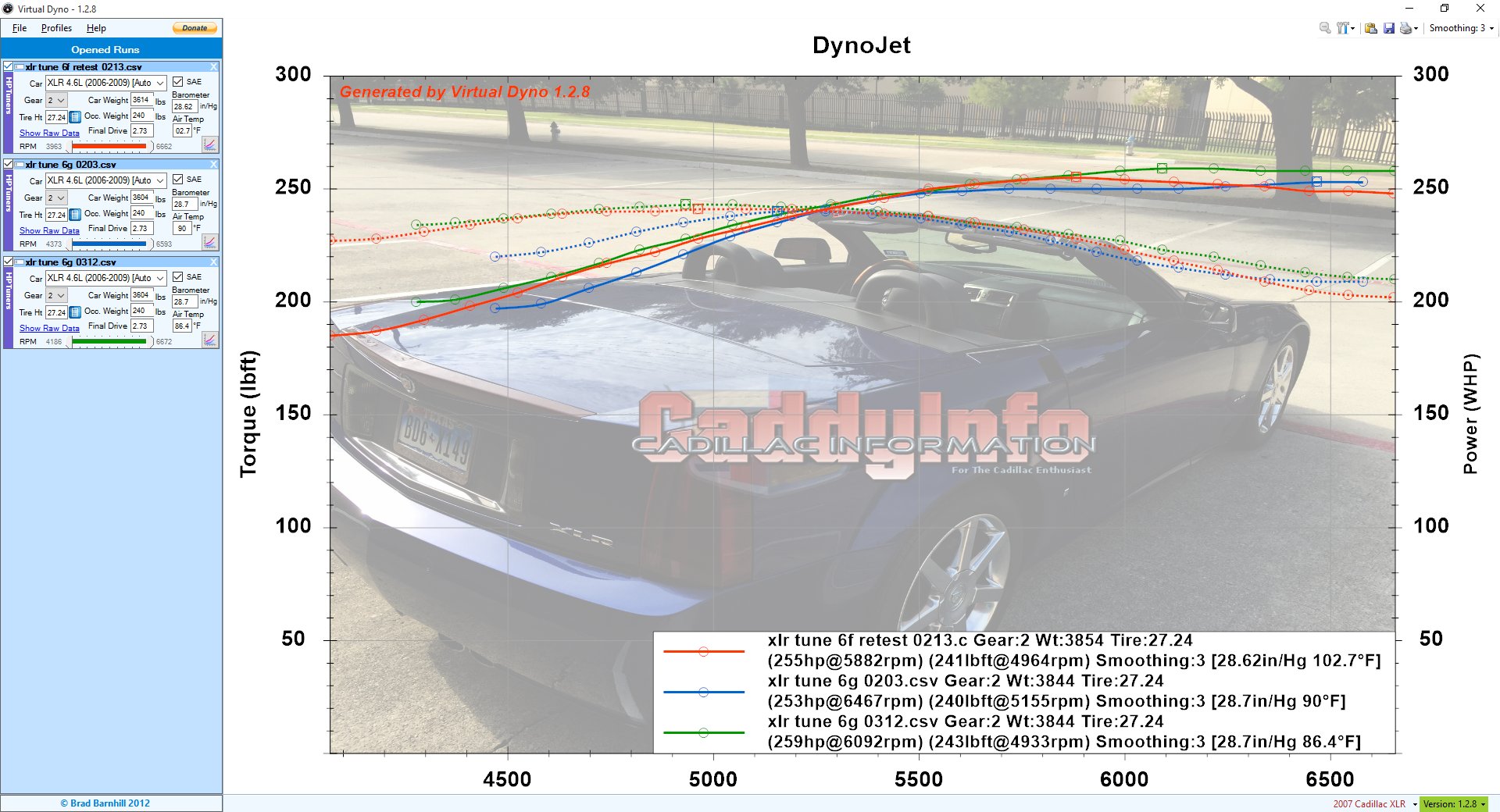
Run 1, named 6G-0203 for the timestamp, was worse than 6F-Retest, and Run 2, named 6G-0312, which was better.  In fact, 6G-0312 was the best result to date, at 259 whp.  Average intake air was slightly cooler for 6G-0312 due to more air through the system.

XLR Tune 6G both and compare to 6F Retest

Today’s runs compared to 6F-Retest

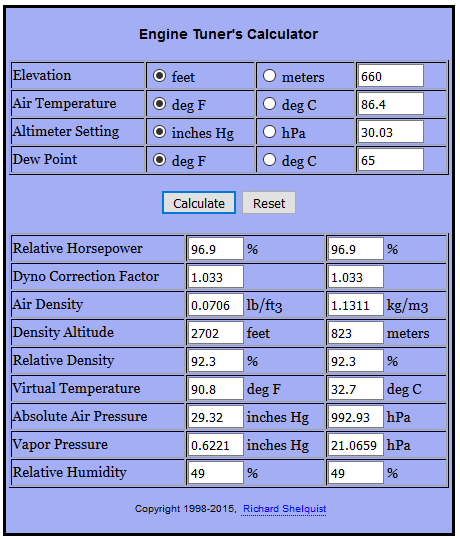
XLR Tune 6G Weather Correction

The weather adjustment for today & dyno correction factor.

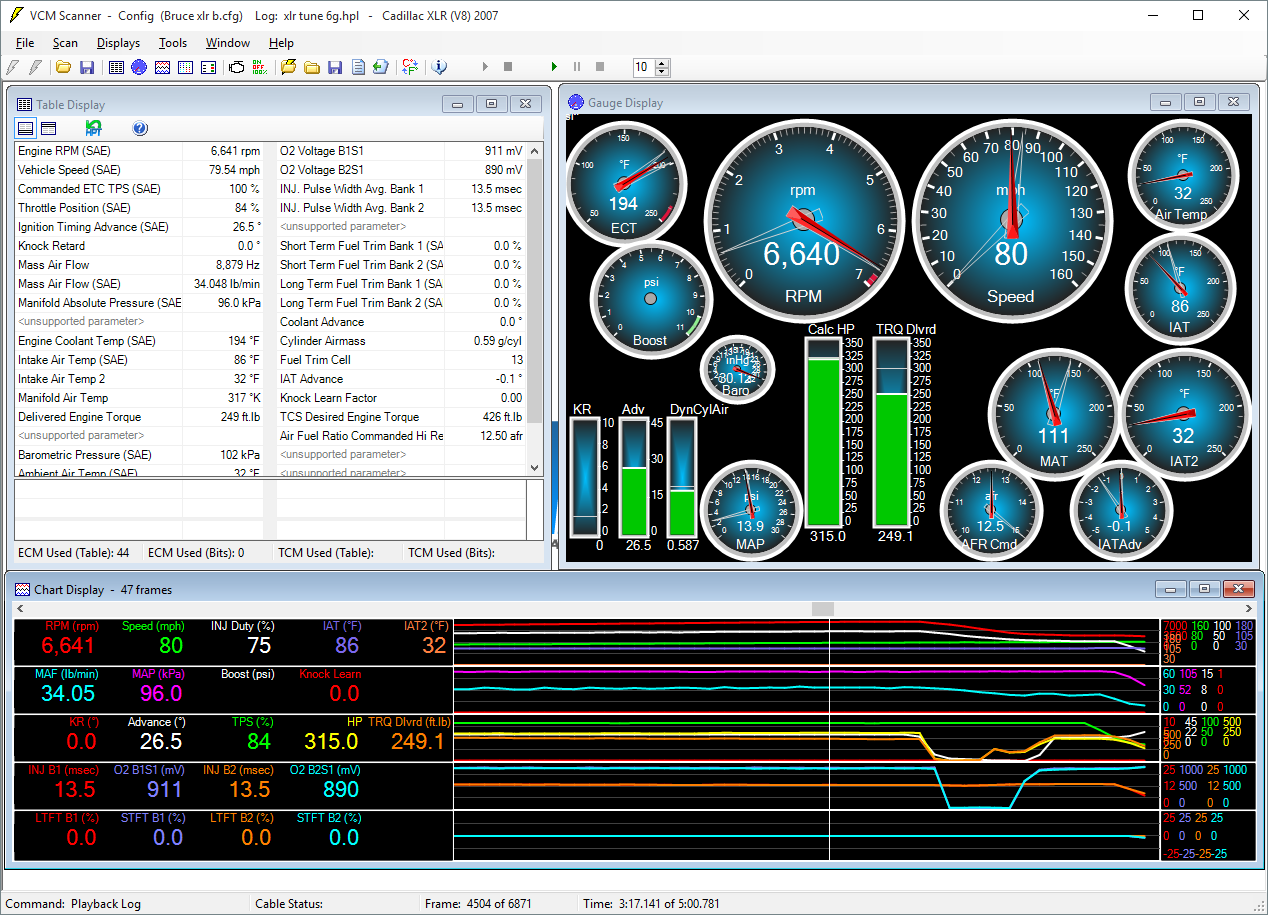
xlr Tune 6G 0312 HPTuners Max HP

The 6G-0312 HPtuners at max HP uncorrected of 315 hp unsmoothed, uncorrected.  Corrected for that run would be 326 hp in 2nd gear.  The 6G-0203 peaked at 317.4 hp uncorrected at 6646 rpm (corrected 327.9 hp in 2nd gear).

For this test I stopped for gas after the test so the weight calc should be right on — I knew how much weight to subtract from full for the test result.

The battery on the laptop is spotty, and I have ordered a new one.  Amazon refunded the cost of the existing battery (Go Amazon!)  Hopefully that will improve the scanner freezing issue, although the laptop is not freezing — the scanner simply stops reporting results, which is more likely some XLR to scanner issue.  Next will be more baseline runs for 6G to resolve today’s variance from test to test.

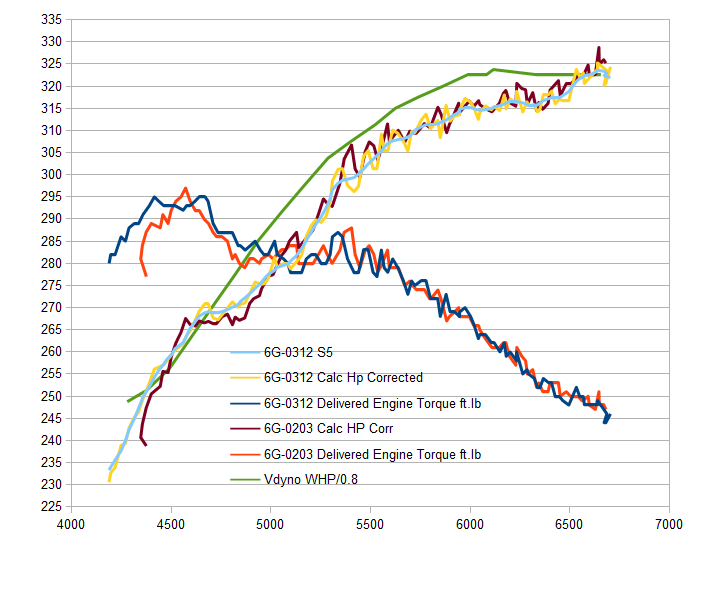
XLR Tune 6G VDyno Comparison to Calc HP Corrected

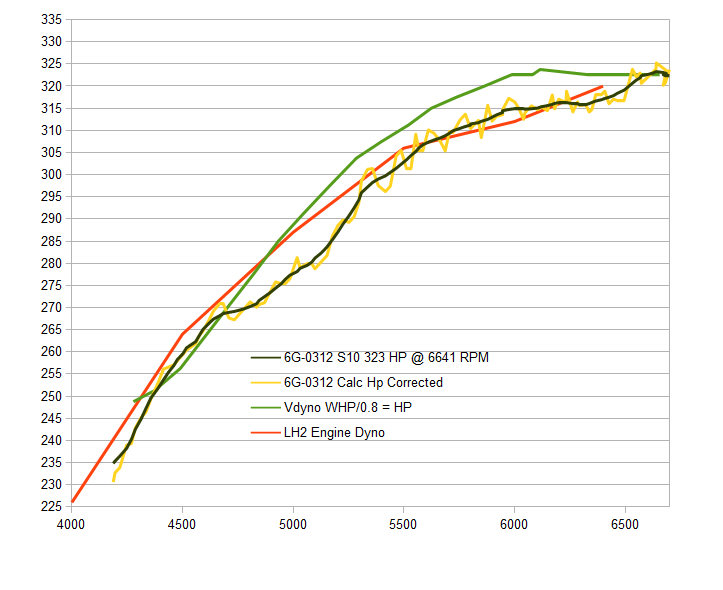
This is a comparison of the corrected calculated HP compared to the Virtual Dyno WHP / 0.8 (automatic).   The light blue line is a smoothed version of the 6G-0312 calculated corrected HP using average smoothing applied 5 times.  Compare that to the Green line for fit.  The Virtual Dyno / 08 is 2.5% above the calculated corrected HP curve along the run of the curve 5250-6500 rpm, which is a pretty close fit.


XLR Tune 6G-0312 Comparison with Engine Dyno

This graph shows a comparison between the 6G-0312 calculated and corrected hp, raw and smoothed, the Virtual Dyno 2nd gear whp converted to engine hp, and Cadillac’s engine dyno for an LH2.  My conclusion is the various sources of data are tying out well.  There is a dip in the calculated not in the virtual dyno between 4600-5200 rpm. I believe that same dip was there in the OEM tune.

I still don’t know how to correct for 2nd gear versus 4th gear, which is closer to 1:1 for the Virtual Dyno result.  My supposition is that a chassis dyno would be higher in 4th gear than 2nd due to lower gear losses.