
Re: Cadillac killed the Electric Car (in 1912 with the electric starter)

The National Post has an interesting article Cadillac killed the electric car explaining a popular theory that the electric car originally lost out to its gasoline competitor once Cadillac developed the electric starter.  Although I like the logic of this also, by 1912 when Cadillac created the electric starter I believe that the gas powered car had already become dominant.  The electric starter was important to the continued development and enjoyment of gasoline powered cars by everyone (and SAFER!).

Charles Kettering, GM Engineer, with the first electric starter

Early cars were steam powered, or battery powered, or electric, or gas powered.  It was an open market, full of innovators and experimentation.  The reason the current conventions for the automobile developed was natural selection — survival of the fittest.  As each innovation or approach came to market, the public selected and bought the ones that were the most useful, and features of those models were copied or emulated by competitors.  Just over 100 years later we have today’s somewhat homogeneous automobiles.

If we all drove electric cars and someone suddenly developed a gasoline car today it would be viewed as a masterpiece.  The internal combustion engine gives the greatest independence, the quickest recharge, and the lightest, most efficient package of any of the technologies we know today.  The major drawbacks are emissions, which we have largely solved in modern automobiles via the catalytic converter, and the use of non-renewable fossil fuels.  Current gasoline is often E10, or 10% Ethanol; and many flex-fuel cars can run on E85, or 85% ethanol / 15% gasoline.  It is fair then to say that we can run many of today’s internal combustion engines on renewable fuels, and continue to eliminate non-renewable fossil fuels.

The reason I am so excited about extended range electric vehicles (EREV)  like the Chevrolet Volt or the Cadillac Converj Concept is that they give options.  Every vehicle can be characterized by stored energy (in the form of gasoline for conventional cars), and time of refueling (visiting a gas station, or plugging in to house current for an extended range electric vehicle).  What the EREVs give us is more options.  In my daily commute I may be able to charge at home, never need to use the gas mode, and seldom need to refuel at a gas station.  That convenience is important to me.  I am unlikely to be able to generate more gasoline at home.  There are however ways to generate electricity safely at home (solar).  Even drawing off the grid however just the convenience of a car that automatically refuels itself in my garage is an improvement.

Plug-in hybrids like the Cadillac XTS Concept have a different mix of attributes along that same range.  How much battery should a hybrid carry?  Enough to run the automobile for 10 miles or 20 miles or 40 miles?  The trade off is in weight for the battery, and oddly enough in time of recharge.  If I only commute 10 miles a day, I don’t need a 40 mile battery.  GM’s two-mode Hybrids today such as in the Escalade Hybrid tend to be able to travel in electric-only mode only at slow speeds and for only a very short range.  The plug-in hybrids (designed to plug in to wall current and recharge overnight) will have an extended battery reserve, and an extended range.  In question is how far that extended range should be.  The first full EREVs will have a 40 mile range and so a LOT of battery power and weight.  I am hopeful the plug in hybrids will have a 20 mile range, which would give me a lot of options in my commute.

This is a terrific time for the automobile.  We have higher performance vehicles than ever before, cleaner vehicles than ever before, and safer vehicles than ever before.  The new vehicles are promising to be even better than the ones we drive today.  I am very optimistic that Cadillac is bringing automobiles to market that will continue to provide enjoyment for automobile lovers.
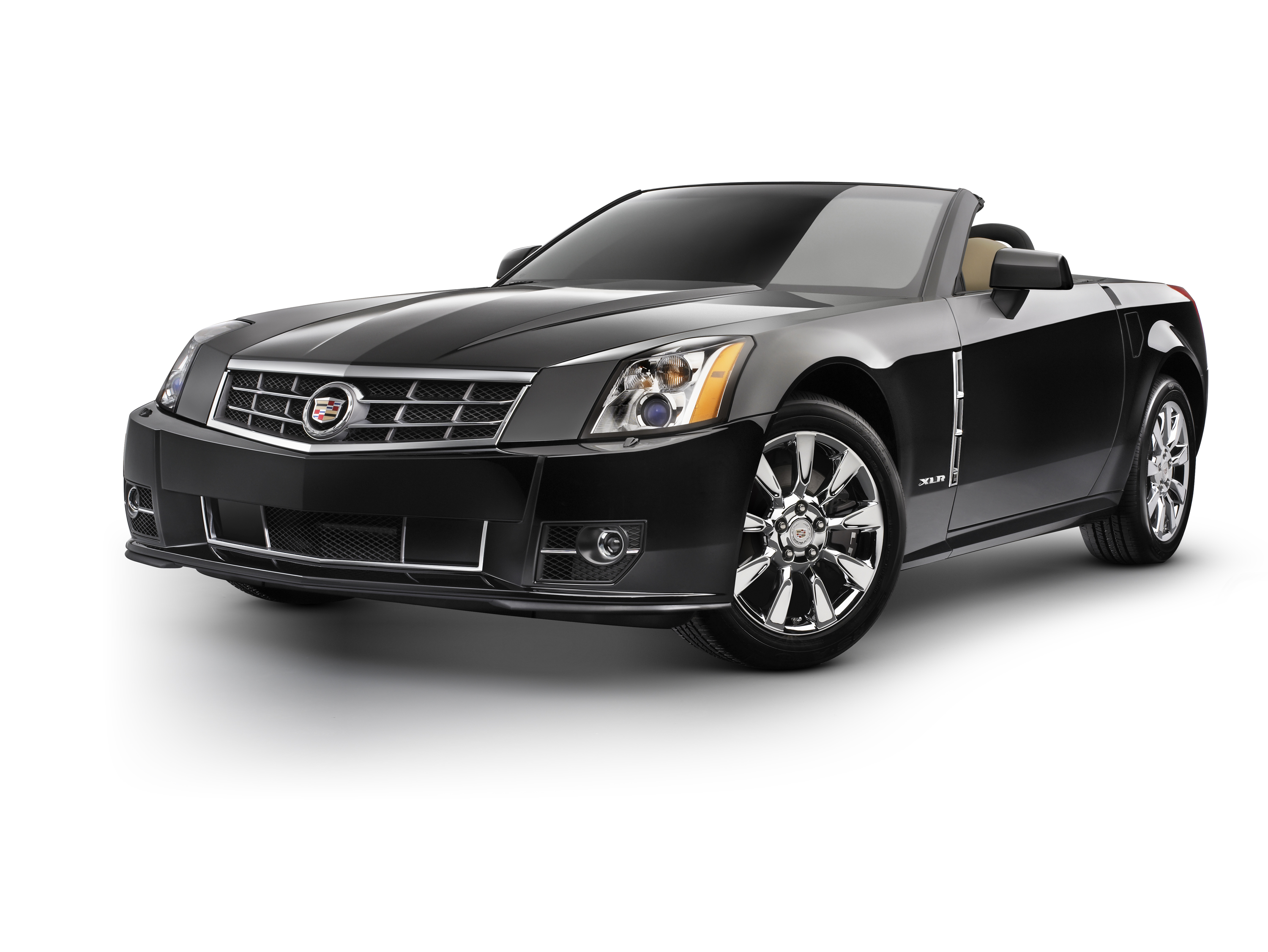
Cadillac XLR – oh we barely knew ye

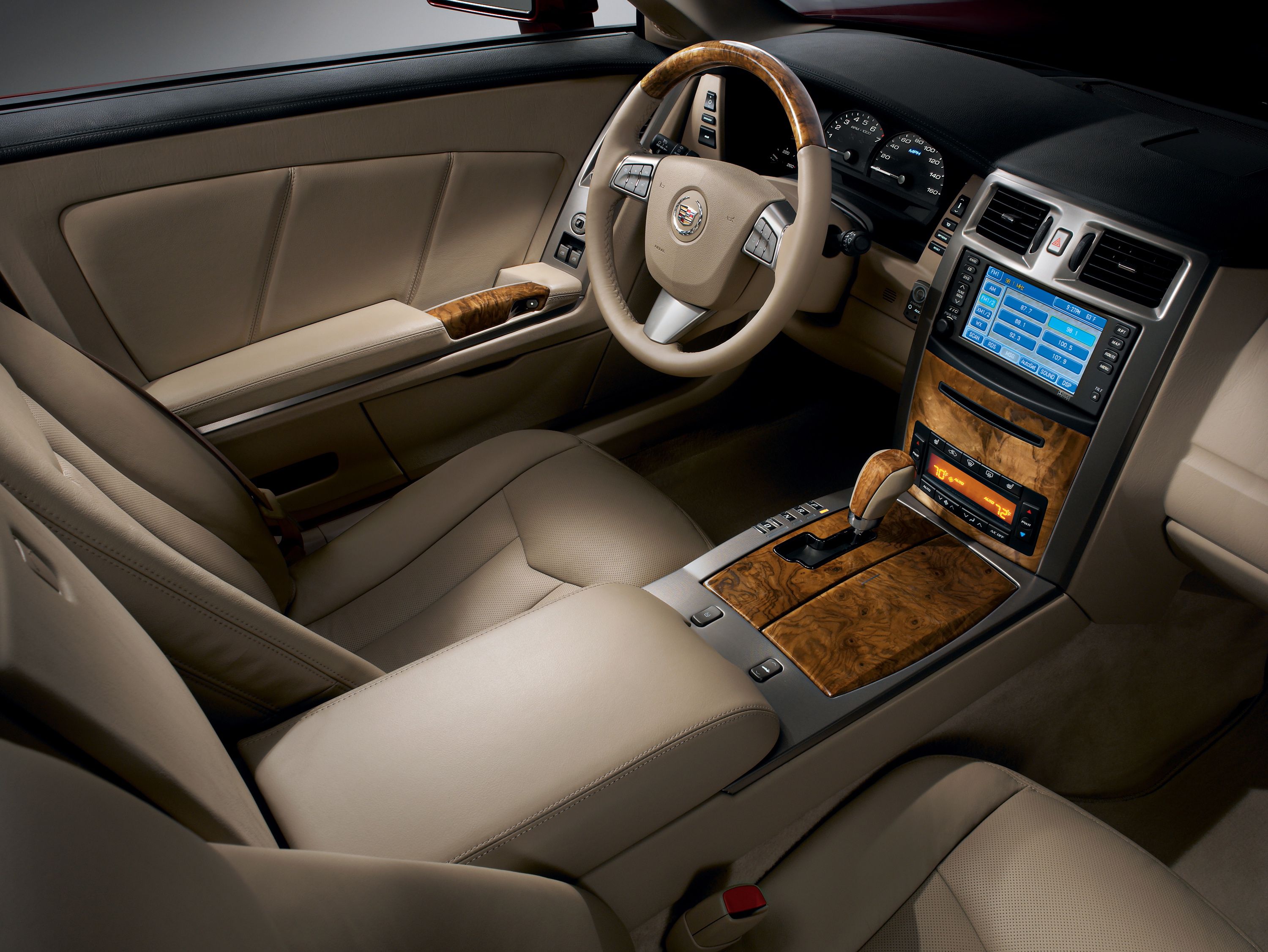
In 2004 Cadillac introduced the Cadillac XLR (Experimental Luxury Roadster).  Featuring an enhanced Corvette chassis and the Cadillac Northstar Engine, the new XLR was the very first car available with the magnetic MR suspension.  I covered the XLR in detail here, but I love these images of the final, 2009 XLR;

And what a luxurious interior:

It is a sort of standing joke that as soon as Automobile Manufacturers really get a model ‘right’ they cancel it. Farewell XLR.

On the other hand, welcome to interesting future used car value.  With low production numbers and wonderful appointments, the Cadillac XLR will be a unique choice for years to come.  Certainly not a car you will see everywhere.  The V8 model with 320 hp has adequate power, and of course the V Series model is available if you need more.

Final Specifications for the 2009 Cadillac XLR:

Overview

Model: Cadillac XLR Platinum and XLR-V luxury roadsters
Body style / driveline: XLR Platinum: 2-door hardtop convertible with rear-wheel drive
XLR-V: 2-door high-performance hardtop convertible with rear-wheel drive
Construction: hydroformed perimeter frame, structural center tunnel, aluminum cockpit frame
Manufacturing location: Bowling Green, Ky.
Key competitors: XLR Platinum: Mercedes-Benz SL500, Lexus SC 430, Jaguar Xk8
XLR-V: Mercedes Benz SL 55 AMG Roadster, Lexus SC Convertible, Jaguar XKR Convertible

Engines

Type: Northstar 4.6L V-8 VVT (variable valve timing) Northstar V-8 SC
(supercharged 4.4L DOHC V-8)
Application: XLR Platinum XLR-V
Displacement 279 / 4565 267 / 4371
Bore & stroke (in / mm): 3.66 x 3.31 / 93 x 84 3.58 x 3.31 / 91 x 84
Block material: cast aluminum upper – sand-cast 319 T7 aluminum
lower – die-cast aluminum
Cylinder head material: cast aluminum 319 T7 semi-permanent mold cast aluminum alloy
Crankshaft material: forged steel cast nodular iron
Valvetrain: DOHC, 4 valves per cylinder, four-cam continuously variable valve timing roller follower DOHC, 4 valves per cylinder, variable valve timing
Ignition system: coil-on-plug ignition, with extended-life dual platinum-tipped spark plugs coil-on-plug with extended-life dual platinum-tipped spark plugs
Fuel system: sequential electronic fuel injection returnless, electronic sequential fuel injection
Compression ratio: 10.5:1 9.0:1
Horsepower (hp / kW @ rpm): 320 / 239 @ 6400 443 / 330 @ 6400 rpm (SAE certified)*
Torque (lb-ft / Nm @ rpm): 310 / 420 @ 4400 414 / 561 @ 3900 rpm (SAE certified)* 90 percent of peak torque available between 2200 and 6000 rpm
Recommended fuel: premium recommended but not required premium required
Max. engine speed (rpm): 6750 6700
EPA estimated fuel economy
(city / hwy):
15 / 24 14 / 21

Transmissions

Type: Hydra-Matic 6L80 six-speed, electronically controlled automatic
Application: XLR, XLR-V
Gear ratios:
First: 4.03:1
Second: 2.36
Third: 1.53
Fourth: 1.15
Fifth: 0.85
Sixth: 0.67
Reverse: 3.06
Final drive: 2.56
Max. shift speed (rpm): 6500

Chassis/Suspension

Front: short/long arm ( SLA) double wishbone, cast aluminum upper and lower control arms, transverse-mounted composite leaf spring, Magnetic Ride Control
Rear: short/long arm ( SLA) double wishbone, cast aluminum upper and lower control arms, transverse-mounted composite leaf spring, Magnetic Ride Control
Traction control system: full-range
Stabilizer bar: front: hollow, 28.6 mm x 4.5 mm wall thickness

rear: hollow, 23.6 mm x 3.5 mm wall thickness

Steering ratio: 17.2:1
Steering type: Magnasteer power-assisted rack-and-pinion
Steering wheel turns, lock-to-lock: 2.9
Turning circle, curb-to-curb (ft / m): 39 / 11.9

Brakes

Type: XLR: power-assisted disc with 4-channel ABS, front and rear

XLR-V: heavy-duty with cross-drilled rotors and high-performance brake linings, dual-piston front calipers and single-piston rear calipers. Power-assist with 4-channel ABS front and rear.

Rotor diameter x thickness (in / mm): XLR: front: 12.8 x 1.3 / 325 x 32; rear: 12.0 x 1.0 / 305 x 26
XLR-V: front: 13.4 x 1.3 / 340.4 x 32; rear: 13 x 1 / 330.2 x 26

Wheels/Tires

Wheel size and type: XLR: std: spun-cast painted aluminum, 18-inch x 8-inch; opt: chrome, 18-inch x 8-inch
XLR-V: std: painted aluminum, 19-inch x 8.5-inch; opt: chrome, 19-inch x 8.5-inch
Tires: XLR: P235/50R18 – Goodyear EMT Run Flat
XLR-V: P235/45R19 – Pirelli Run Flat

Dimensions
Exterior

Length (in / mm): 177.7 / 4513
Width (in / mm): 72.3 / 1836
Height (in / mm): 50.4 / 1279
Wheelbase (in / mm): 105.7 / 2685
Track (in / mm): XLR – 61.6 / 1564 (front); 62.1 / 1578 (rear)
XLR-V – 62.2 / 1580 (front); 62.2 / 1580 (rear)

Interior

Seating capacity (front / rear): 2 / 0
Headroom (in / mm): 37.6 / 955
Legroom (in / mm): 42.6 / 1083
Shoulder room (in / mm): 54.3 / 1380
Hip room (in / mm): 53 / 1346

Capacities

Cargo volume (cu ft / L):
Top up: 11.6 / 328
Top down: 4.4 / 125
Fuel tank: (gal / L): 18 / 68.1
Engine oil (qt / L): 8 / 7.5
Curb weight (lb / kg) estimated: 3804 / 1726

Eliminating Wheel-hop — 1st Gen Cadillac CTS-V

The 2004-2007 Cadillac CTS-V is an excellent performance luxury sedan.  With a 400 hp LS Series V8, Brembo brakes, sport suspension, and Cadillac appointments, the first Generation CTS-V is an intriguing automobile, and a terrific used Sports Sedan value.

One weakness frequently discussed for the 1st Generation CTS-V is wheel hop.  Wheel hop happens when instead of a tire/wheel transmitting power smooth to the car, or spinning, instead literally ‘hops’ in an up and down vertical motion.  This can lead to parts destruction in rapid fashion.

For the 2nd generation CTS-V Cadillac found a solution — by making the left and right rear axles different diameters, wheel-hop was solved.  Under load, both axles have torsional spring rates; this asymmetry decouples any resonance between them, reducing axle hop.

GForce and Hendrix Engineering have come out with retro-fit kits for the 1st Generation CTS-V’s that take a similar approach:

GForce CTS-V Kit

Here is how GForce describes their kit:

04-07 CTS-V ANTI-WHEEL HOP DRIVER AND PASSENGER SIDE AXLE KIT

The GForce $549 kit includes:

Driver side 300m Axle
Passenger side big diameter 300m axle
CV Boots
CV Clamps
CV Grease

The best solution to eliminating wheel hop is to replace both the drivers side and passenger side axles with our big and little axle kit. We designed our axle kit to provide a properly sized set of axles that will eliminate most all wheel hop in most all conditions. The trick is to have a staggered axle diameter from side to side that will break up the harmonics associated with wheel hop. Several things come into play with our design such as material, heat treating procedures, weight and twisting properties

We make our axles from billet 300m steel, the strongest material available for making drivetrain products, much stronger then chromoly. We only use certified aircraft grade 300m material for our axles.

These axles will work on all 04-07 CTS-V’s.

The best thing about our 300m axles is the fact they are compatible with either the OEM inner and outer stubs or our line of inner and outer billet stubs for the CTS-V. If you ever want to up-grade to billet stubs down the road, you just buy the stubs, swap them in and your good to go for 1000 hp. A totally modular design! This kit is for the auto enthusiast that doesn’t mind getting his hands dirty. Once the half shafts are removed from the car, it is about a one hour job per side to swap the axles out with the OEM axles.

Alternate approach: For 04-05 gets the big passenger side axle; For 06-07 gets the smaller drivers side axle. I recommend you get both as above.

The Hendrix Engineering offer includes the bar and parts for the swap and one can have it swapped locally, or one can send an axle and Hendrix Engineering will  swap it out and shoot it back.  The kit costs $329 plus S&H.  If you have them install the axle it is $379. All of the Hendrix Econo Axles are driver side and they work on all years.  Unfortunately I could not find any information about their system on their website, but they appear to be responsive if contacted directly.

For more information see: