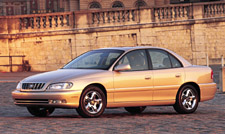
Major Enhancements Keep Seville Competitive In Global Luxury Market
Less than 24 months after its worldwide introduction, the 2000 Seville receives significant vehicle and system enhancements to keep it competitive in the contentious global prestige-luxury sedan segment.
Featuring an improved Northstar System for 2000 — which includes a redesigned engine and the next evolution of the StabiliTrak™ system — Seville also benefits from increased safety features and infotainment.
With 275 and 300 horsepower variants, the 4.6-liter aluminum 32-valve Northstar V8 remains the heart of the 2000 Seville lineup. The redesign of the engine focused on significantly lowering emissions, quieter operation (without losing the “pleasing” performance note that has long been a signature of the engine) and better fuel economy running on regular fuel. The engine features an all-new head design, new intake manifolds, coil-on-plug ignition and rolling cam runners to reduce friction. Additionally, virtually all other components were changed or updated, including the pistons, valves, connecting rods and cams.
A new version of StabiliTrak will be introduced in the 2000 model year as standard on the STS and SLS. This enhanced version is designated StabiliTrak 2.0 because of the scope of improvements, which include side slip-rate control and active steering effort compensation.
In addition to the new StabiliTrak 2.0, the STS and the SLS will also come equipped with three significant enhancements to the continuously variable road-sensing suspension (CVRSS): transient roll control, lateral support and stability control interaction — all of which are made possible by integrating CVRSS into the StabiliTrak equation.
Seville continues to set industry standards in safety. The 2000 Seville features a first-of-its-kind passenger side frontal air bag system with sensors that are intended to keep the air bag from deploying if the front passenger seat is occupied by a small child, or if the seat is not occupied. The air bag suppression system provides safety benefits to children that cannot be realized with dual-stage or multi-stage inflation systems, which deploy with varying degrees of force depending upon the size of the passenger and the severity of the crash.
Cadillac’s system utilizes innovative sensor technology and advanced computer programming to determine the type of occupant on the seat. These weight-based sensors, coupled with pattern recognition technology, distinguish between a small adult female whose weight may be similar to a large child restrained in a child safety seat. If the front passenger seat is occupied by a small child — whether in a child safety seat or not — the air bag will not deploy.
Since most responsible drivers will want to know the status of the passenger air bag, the system is equipped with an indicator light on the rearview mirror that will read “on” if the air bag is enabled, and “off” if it is suppressed.
Cadillac still recommends the back seat as the safest place for children. However, customer research indicates that people want — when absolutely necessary — the ability to properly restrain children in the front seat.
Seville will make parking safer and easier for drivers with the application of Ultrasonic Rear Parking Assist. Using ultrasonic sensors located in the Seville’s bumper, rear parking assist detects objects within approximately five feet and notifies the driver of the object’s proximity through a series of chimes and lights.
An advanced navigation system is an available option on the STS and SLS for 2000. The system is similar to the one introduced for the Japanese-market editions of the 1998 Seville. The five-inch color display screen, centrally located in the instrument panel, is integrated into the Bose® 4.0 music system with touch screen controls. For bright, clear graphics, the touch sensitive screen uses the active-matrix thin-film-transistor technology common in laptops. The CD-ROM based system provides turn-by-turn or map assistance while traveling. It can also speak five languages.
Customers in more than 40 countries will benefit from all these enhancements, as the 2000 Seville continues to play the leading role in Cadillac’s revitalization as a global brand. Since being introduced in 1998, Seville export sales have doubled from 5 percent to 10 percent of total Seville sales.
Offered in both right-hand and left-hand-drive versions, export versions of the Seville are less than five meters in length (4995mm/196.5 inches), an important consideration in densely populated European and Asian cities.
In the U.S. market, the 2000 Seville offers a simplified, integrated three-button OnStar system without the need for a handset phone. The OnStar three-button system has its own dedicated cellular network, eliminating the need of an additional cellular contract. This simplified system allows drivers to benefit from all of OnStar’s safety, security, and convenience features while keeping their eyes on the road and hands on the wheel.
Exterior
Seville’s styling is sophisticated yet distinctly American. Designers refer to Seville’s overall balance between leanness and a muscular appearance as “controlled sculpting.” In customer research, it rated higher than any competitor.
The Seville’s exterior design is evolutionary, providing a cleaner, more aerodynamic interpretation of the aggressive look of the 1992-97 models. This is not only important in North America, where Seville has a large and loyal following, but also in overseas markets, where the Seville’s distinctive look is widely recognized and appreciated.
For 2000, Seville’s sophisticated exterior styling will be enhanced by the addition of two new exterior colors: Midnight Blue and Bronzemist.
Interior
Seville’s interior sets a new standard for luxurious functionality. An independent, third-party testing company found the functionality in Seville is superior to the previous leader in this area, the Lexus LS400.
Seville’s interior designers created a car in harmony with the driver and passengers. Controls are strategically placed, with the controls that are most frequently used closest to the driver. Easy-to-use remote controls for important functions have been placed on the steering wheel, and all controls are placed where the user would logically expect them to be.
Seville’s interior features a wealth of storage areas designed for easy use. For example, the center console can hold compact disc cases oriented either side-to-side or front-to-rear, depending on the driver’s preferences. The glove box door includes a tissue dispenser and an extra storage bin. A pass-through in the rear seat allows skis or other long items to be safely carried inside the car.
Leather is standard in the United States and in many export markets. For 2000, the four available interior colors are Shale, Black, Wheat and Pewter.
Driver Information System
Seville’s driver information system can display five languages — English, German, Japanese, Spanish and French. The system provides detailed information on the operation of the vehicle and numerous alert messages, as well as telephone information for the optional hands-free cellular phone. The digital speedometer read-out can be projected as a virtual display on the instrument cluster.
The standard North American sound system in the SLS is a Delco AM/FM system with cassette and in-dash CD capabilities, featuring eight speakers and 250 watts of power. A console-housed six-disc CD changer is available, and MiniDisc™ player is available only with the Bose® 4.0 system.
Bose 4.0 System
The Bose 4.0 music system is the best sound system ever developed for a production automobile. Optional on the SLS and standard on the STS, the system features an impressive list of proprietary, state-of-the-art speaker and electronic technologies. The amplifier, rated at 425 watts average power output, drives eight specially tuned speakers. Tuned specifically to the acoustic characteristics of the Seville’s interior, the Bose 4.0 system can produce live concert level volumes without audible distortion.
The Bose 4.0 music system was produced in a “clean sheet” collaboration between Bose Corp. acousticians and Cadillac engineers. From the beginning, the Bose team realized that the Seville’s music system must be meticulously tailored to the acoustic space in which it must work: the interior of the vehicle.
The system was developed to deliver musical sound that is natural and lifelike in every regard. One of the key contributors to the system’s performance is custom equalization. The system also employs numerous advanced technologies, many invented and developed by Bose, and it is a showcase for psychoacoustic research, advanced acoustics and electronics technologies.
Radio Data System
Seville’s radio data system (RDS) allows the radio to receive digital data transmitted along with the standard FM radio signal. This information can include station call letters, program format, the name of the song and the artist playing, and other useful information. RDS also makes it easier to find traffic and emergency information.
RDS allows Seville buyers to personalize their radio to provide them whatever information they want, whether it’s viewing stock quotes or searching for jazz stations.
Another useful feature of RDS is the traffic announcement function. When a traffic announcement is broadcast, passengers will hear it even if a CD or cassette tape is playing.
Commuters will appreciate the traffic announcement function of RDS. When the traffic announcement feature is turned on, the radio looks for a station that broadcasts traffic reports. This feature enables the radio to temporarily interrupt the audio program, including CD and cassette tape, with updated traffic conditions.
A key safety feature of RDS is its alert system that will even interrupt a CD or tape to let listeners know of impending local or national emergencies.
Another feature of the radio is the weather band, which allows customers to get National Weather Service reports 24 hours a day.
Theftlocktm
All Seville radios are equipped with Theftlock™, which provides automatic theft deterrence for the radio. If the radio is removed from the car, it won’t work in any other vehicle unless the vehicle identification number (VIN) is cleared. This can only be done by a dealership using a special tool. Once the VIN is scribed into the radio, the radio can be traced.
Adaptive Seating
Adaptive seating remains a Seville exclusive technology, available as an option on the SLS as well as the STS for both driver and front seat passenger. Seville’s adaptive seat represents the first automotive application of a technology initially used in hospital burn units. Adaptive seating results in less fatigue and more comfort, even after many hours of driving.
Adaptive seating automatically recognizes occupant position and adjusts the seat’s support to custom fit every individual. The technology uses a network of 10 air cells, located between the leather upholstery and foam in the seat cushion and back. Sensors attached to these air cells measure internal pressure and supply that information to a control module, which compares the measurements to an optimal pressure pattern stored in its memory. If a discrepancy exists, pressure inside the air cells is adjusted.
There are three air cells in the lumbar area, one per each lateral bolster in the backrest, one per each lateral bolster in the bottom cushion, one per each thigh and one under the buttocks. Since the cells under the thighs and in the backrest lateral support bolsters are on a common channel, eight pressure modules serve the 10 cells. An electrically driven compressor mounted in the seat base supplies air pressure.
The initial adjustment procedure takes 30 to 60 seconds. The system cycles every four minutes to adjust air cell pressure as the occupant moves in the seat. An override switch allows customers who prefer more or less lumbar support than in the ideal pattern to adjust support to their preference.
Seville’s adaptive seats offer heat to provide added comfort in cold weather.
Northstar System
In terms of performance, the Seville SLS and STS feature Cadillac’s widely praised Northstar dual overhead cam V8 engine with the enhanced StabiliTrak 2.0 stability control system, enhanced continuously variable road-sensing suspension, all-speed traction control, ABS and Magnasteer™ speed-sensitive steering.
The 2000 Seville benefits from the next step in modern engine design in the form of an improved Northstar V8. While the basic engine architecture remains a predominantly aluminum 4.6-liter DOHC 32-valve V8, major design improvements have been incorporated to deliver lower emissions, excellent mileage with regular fuel, and smoother, quieter operation.
The list of new Northstar V8 features includes:
- Roller-follower valvetrain design
- Improved combustion chamber configuration
- Center-feed intake manifold
- New pistons
- Coil-on-plug cassette ignition system
- Siemens powertrain control module (engine/transmission control computer)
- Exhaust manifolds with integral air-injection passages
- Flex pipe between the exhaust Y-pipe and the catalytic converter
- Twin electrically driven, two-stage air pumps (LEV applications only)
- Direct mounting of all engine-driven accessories (power steering pump, AC compressor, electrical generator)
- Integrated coolant crossover and throttle-body support
The Seville’s fuel recommendation changes from premium (93 octane, lead-free) to regular, resulting in a major reduction in operating expense. To facilitate this gain, the Northstar’s compression ratio was lowered from 10.3:1 to 10.0:1.
One result of these improvements is that the 2000 Seville will be certified for sale in California and certain Northeast states as a low emissions vehicle (LEV). This was achieved by means of a reaction-heated catalyst, pistons with reduced crevice volume and a new combustion chamber design.
Engine Design Changes
Revised combustion chambers are superior to previous designs in terms of both tumble motion of the incoming fuel-air mixture and burn rate. The intake and exhaust valves have been resized. Larger intake valves improve the engine’s breathing ability, while smaller exhaust valves increase flow velocity, an aid to catalyst light off.
While the new combustion chamber design helps maximize fuel efficiency, even larger gains are made by the addition of roller-follower devices between each cam lobe and valve stem. Compared to the previous Northstar’s direct valve actuation, the result is a substantial reduction in friction. During moderate driving conditions, the torque necessary to turn Northstar’s four camshafts is reduced by 50 percent or more.
The Northstar also benefits from a new ignition system that delivers power to the spark plugs directly instead of through wiring. A cassette containing four ignition coils linked by short secondary leads to adjoining spark plugs now attaches atop each cylinder head cover.
In addition to improved reliability, the new ignition system permits scheduling the magnitude of the voltage sent to the spark plugs. High voltage is used during full-load, high rpm and heavy EGR (exhaust gas recirculation) conditions to guarantee complete combustion. The energy level is reduced to minimize electrical loads and radio frequency interference during light-load conditions, such as medium speed cruising. The result is extended spark-plug life and a peak energy capacity that is 130 percent higher than the system it replaced.
Northstar’s new powertrain control module is a single circuit board device housed within a sealed aluminum case engineered to withstand the harsh underhood environment. The module contains dual microprocessors to monitor and direct engine and transmission operations.
Noise and vibration improvements are the result of adopting a center-feed design for the composite-plastic intake manifold, as opposed to the previous end-feed design. The new design facilitates a near equal-length induction path for all eight cylinders. In contrast, the previous design provided a long path to the front cylinders and shorter paths to rearward cylinders. With the reduction or elimination of many harmonic tones, the resulting induction sound is more of a hum.
A molded-plastic cover backed with acoustical foam rests above the intake manifold to reduce induction, fuel-injector and other noises radiated by the engine. Direct mounting of accessories eliminates flex and vibration inherent with extra brackets. A flexible connection in the exhaust system en route to the catalyst helps quell another source of noise and harshness.
Outstanding Power, Torque
The 4.6-liter dual-overhead-camshaft Northstar V8 installed in the SLS generates 275 horsepower (205 kW) at 5600 rpm and 300 lb.-ft. (407 N•m) of torque at 4000 rpm. The sportier STS is equipped with a retuned version of the Northstar V8 producing 300 horsepower (224 kW) at 6000 rpm and 295 lb.-ft. (400 N•m) of torque at 4400 rpm.
The redline of the SLS is 6500 rpm and 6700 rpm in the STS.
The Northstar engines offer 100,000-mile (160,000-kilometers) durability and limp-home mode in case of total coolant loss. The Northstar’s maintenance-free design allows the car to go up to 100,000 miles before its first scheduled tune-up — only changing the oil, oil filter and air filter. In limp-home mode, the engine can operate on four cylinders at speeds of 50 mph (80 kph) for about 50 miles (80 kilometers), giving the driver an opportunity to reach a safe location. The engine accomplishes this by alternately delivering fuel to four of the eight cylinders. The remaining four cylinders do not fire but continue to pump air, which cools the engine.
On both SLS and STS, the 4T80-E transaxle is linked to the engine via a viscous converter clutch, which assures smooth operation by reducing torque variation when the torque converter clutch is applied. The 4T80-E also features equal-length drive axles, which limit torque steer by minimizing angle differences from side to side as the car accelerates.
Performance Algorithm Shifting
Exclusive to STS, the Performance Algorithm Shifting (PAS) feature programs the gearbox to perform intuitively like a manual during aggressive driving. PAS uses vehicle sensors, including the lateral acceleration sensor provided for StabiliTrak, to evaluate the driver’s intentions. It takes its evaluation and programs the transmission to respond much like a manual gearbox during high-energy driving.
For example, during hard cornering, the “smart” transmission will hold its gear to prevent mid-corner upshifts that can upset the balance of the car. When braking for a corner, the transmission will change down to the correct gear for the cornering speed, just as a skilled driver would do with a manual gearbox, and maintain the gear selection through acceleration out of the corner.
Unlike so-called adaptive systems, which attempt to deduce what gear the driver might want from previous behavior, PAS adjusts virtually instantaneously in real time. The transmission shift performance is clearly intuitive and deployed well within the high-performance operating envelope of the STS.
StabiliTrak™
Standard on the STS and SLS is an enhanced version of the most advanced integrated stability control system in the world, StabiliTrak 2.0. Sensors in the vehicle measure steering angle and other inputs from the driver, to determine what he or she wants the car to do. If the car isn’t responding appropriately, a computer selectively applies the appropriate individual front brakes to help keep the car on the intended course.
The StabiliTrak engineered into the 2000 Seville is actually a third-generation of this important active safety breakthrough. One new feature is active steering effort compensation (ASEC). During low-traction or emergency-maneuver situations, the steering effort is temporarily raised. StabiliTrak achieves this by commanding the Magnasteer system to reduce the degree of power assist. Combining steering assist level with stability control is an industry first that was achieved solely through software calibrations with no added hardware, cost or mass.
Side slip-rate control is a second feature added to StabiliTrak for the 2000 model year. In the event a Seville loses lateral traction at both front and rear axles and experiences the onset of significant side slip, both front brakes are momentarily applied to slow the vehicle in order to regain stability and lateral traction. Side slip is calculated by analyzing data from the lateral acceleration sensor. Similar to ASEC, no additional hardware is necessary.
Continuously Variable Road-Sensing Suspension
All Sevilles are equipped with continuously variable road-sensing suspension (CVRSS), which produces optimum body and wheel damping under virtually all driving conditions by independently adjusting the damper setting at each corner of the vehicle and responding in real time. CVRSS can precisely match damping required to the severity of the input, enabling a refinement level not previously achieved. The benefits to the Seville customer include markedly improved rolling smoothness, road isolation and impact feel, with exceptional control during aggressive emergency maneuvers.
For 2000, Seville benefits from the following upgrades to CVRSS:
- Transient roll control: This enhancement calculates the steering wheel velocity by using the steering angle sensor. Transient roll is improved by stiffening the outside dampers in compression and stiffening the inside dampers in rebound.
- Lateral support: This feature uses the lateral acceleration signal to improve vehicle lateral support by stiffening the outside dampers in compression and the inside dampers in rebound, effectively “wedging” the car, or decreasing lateral load transfer in the turn. This means that as the vehicle reaches steady state, the damper settings become optimized for road-holding to improve tire-to-road contact.
- Stability control interaction: During a StabiliTrak activation, the front corner with the brake applied will be stiffened in compression, while the opposite rear corner damper is stiffened in rebound. This effectively reduces the front corner “dip” that would otherwise be caused by brake activation, and limits the loss of normal force at the opposite rear tire patch. The result is flatter body control and better wheel control, which results in better vehicle handling.
Magnasteer™
The Seville’s Magnasteer variable-assist, speed-sensitive power rack and pinion steering system uses a variable magnetic field to increase or decrease steering effort as needed. As a result, the range of adjustability is greater and has no steps or irregularities in the boost curves. For quick response, Seville uses a straight 14.8:1 steering gear ratio rather than a variable ratio.
An enhanced feature of Seville’s Magnasteer is sensitivity to lateral acceleration. When sensors determine the cornering rate is up, steering effort is automatically increased to enhance the driver’s road feel.
Road-Texture Detection
Seville’s road-texture detection feature makes the anti-lock brakes more effective by measuring the roughness of the road and adjusting brake operation accordingly. Road-texture detection is designed to provide shorter, more consistent stopping distances on rough roads. It also reduces unnecessary ABS engagement and improves steering.
Body Structure And Acoustics
Based on the third generation of GM’s ‘G’ architecture, the Seville’s body structure is designed for excellent stiffness and rigidity, providing responsive handling and a quiet interior. The Seville body structure is 58 percent stiffer in beaming and 53 percent stiffer in torsion (twisting) than the previous Seville, making it competitive with other leading luxury cars.
A mega-pan one-piece floor panel extends from the front of the dash to the rear of the trunk, minimizing joints and seams. The interior body side rings are stamped from a single laser-welded blank, saving weight and cost while improving build quality.
A pair of hydroformed tubes sweep from the base of the windshield into the roof and back down to the rear wheel wells. These tubes help form a safety cage around the passenger compartment, while improving torsional and beaming stiffness of the body structure.
The instrument panel and steering column are supported by a one-piece magnesium cross-car beam to minimize shake and noise. The doors are solidly mounted, with each hinge bolted through two body panels and reinforced composite blocks to better distribute loads for a more substantial feel.
The Seville’s rigid body structure helps keep vibration from the road, powertrain and other sources from reaching passengers. This provides the foundation for making Seville one of the quietest cars in the world.
To this structure, engineers added major noise and vibration controls, including advanced torque-axis engine mounts, which reduce idle noise and shake. To close off road noise, they also added rubber-isolated subframes to the front and rear suspension. The engine mounts, as well as the forward bushings for the front lower control arms, incorporate hydraulic dampers to further isolate powertrain and road inputs.
The alternator is water-cooled for more reliable operation under heavy loads, and it features a chamfered rotor design that keeps changes in the magnetic field from producing a resonant whine. A quieter steering pump, redesigned engine cooling fans and redesigned exhaust outlets also help to reduce unwanted noises.
Seville STS Preliminary Specifications
| Engine |
| Alternator (amp) |
138 |
| Bore x Stroke (in./mm) |
3.66 x 3.31 / 93.0 x 84.0 |
| Compression Ratio |
10.0:1 |
| Cylinder Head |
Aluminum |
| Displacement (in3/cm3) |
279 / 4565 |
| Emission Control |
Evaporative, 170-cubic inch 3-way catalytic converter, exhaust-gas recirculation, positive crankcase ventilation, OBD-II compliant |
| Engine Block |
Die-cast, open deck, aluminum with cast iron cylinder liners |
| Engine Type |
4.6L DOHC V8 |
| Horsepower (bhp/kW @ rpm) |
300 / 224 @ 6000 |
| Ignition System |
Crank-triggered direct fire with platinum spark plugs |
| Induction System |
Sequential tuned port fuel injection |
| Recommended Fuel |
Unleaded premium (operation on 87 octane fuel is permissible with diminished performance and fuel economy) |
| Redline (rpm) |
6700 |
| Torque (lb.-ft./N•m @ rpm) |
295 / 400 @ 4400 |
| Valvetrain |
2-stage chain-driven double overhead camshafts, direct acting hydraulic roller follower, 4 valves per cylinder |
| |
|
| Driveline |
|
| Drive System Type |
Front engine, front-wheel drive |
| Gear Ratios |
|
|
1st |
2.96:1 |
|
2nd |
1.63:1 |
|
3rd |
1.00:1 |
|
4th |
0.68:1 |
|
Reverse |
2.13:1 |
|
Overall Final Drive Ratio |
3.71:1 |
| Transmission |
Hydra-matic 4T80-E electronically controlled 4-speed automatic w/overdrive and viscous-type torque converter clutch |
| |
|
| Chassis/Suspension |
|
| Braking System |
4-wheel power disc with 4-channel ABS, StabiliTrak and road texture detection |
|
Front Disc |
Size 11.85 x 1.26 / 301 x 32,
(dia. x thick.) (in./mm) vented disc |
|
Rear Disc |
Size 11.61 x .43 / 295 x 11,
(dia. x thick.) (in./mm) solid disc |
| Shock Absorbers (f/r) |
Electronic CVRSS |
| Stabilizer Bar Diameter (in./mm) |
|
|
Front |
1.18 / 30 |
|
Rear |
0.87 / 22 |
| Steering Ratio |
14.8:1 on center |
| Steering Type |
Magnasteer™ variable assist speed sensitive steering, rack and pinion |
| Steering Wheel Turns |
(lock-to-lock) 2.4 |
| Suspension |
Continuously variable road-sensing suspension |
|
Front |
Independent, MacPherson struts, coil springs, stabilizer bar |
|
Rear |
Independent, multi-link, aluminum control arms, lateral toe links, coil springs, solid steel stabilizer bar, automatic level control |
| Tires |
|
|
Standard |
Goodyear Eagle LS H-rated, P235/60R16 |
|
Optional |
Z-rated, P235/60ZR16 |
| Traction Control System |
Full-range |
| Turning Circle, Curb-to-Curb(ft./M) |
40.5 / 12.34 |
| Turning Circle, Wall-to-Wall (ft./M) |
42.7 / 13.03 |
| Wheels (in/mm) |
16 x 7 / 406 x 178, cast aluminum, 7-spokes |
| |
|
| Body/Exterior Dimensions |
|
| Body Type |
Integral body-frame |
| Curb Weight (lb./kg) |
4001 / 1815 |
| Drag Coefficient |
0.31 |
| Ground Clearance, Minimum (in./mm) |
5.0 / 128 |
| Height, Overall (in./mm) |
55.4 / 1406 |
| Length, Overall (in./mm) |
201 / 5105.4 |
| Overhang(in./mm) |
|
|
Front |
45 / 1140 |
|
Rear |
43.9 / 1115 |
| Tread (in./mm) |
|
|
Front |
62.7 / 1593 |
|
Rear |
62.4 / 1586 |
| Vehicle Type |
5-passenger, 4-door sedan |
| Weight Distribution (%, f/r) |
62 / 38 |
| Wheelbase (in./mm) |
112.2 / 2850 |
| Width, Overall (in./mm) |
75 / 1904 |
| |
|
| Interior Dimensions |
|
| |
Front |
Rear |
| Head Room (in./mm) |
38.2 / 969 |
38.0 / 965 |
| Hip Room (in./mm) |
55.6 / 1411 |
57.5 / 1460 |
| Knee Clearance (in./mm) |
– – |
3.7 / 94 |
| Leg Room (in./mm) |
42.5 / 1079 |
38.2 / 970 |
| Shoulder Room (in./mm) |
59.1 / 1501 |
58.0 / 1474 |
| Vehicle Class |
Mid-size |
| Volume (ft3/L) |
|
|
EPA Interior (inc. trunk) |
119.88 / 3045 |
|
Interior Cabin |
104.18 / 2950 |
| |
|
| Capacities |
|
| Battery (volts/cca) |
12 / 880 |
| Cooling System (qt./L) |
12.5 / 11.8 |
| Fuel Tank (gal./L) |
18.5 / 70.7 |
| Oil (qt./L) |
7.0 / 6.6 |
| Tire Inflation Pressures (f/r, psi) |
30 / 30 |
| Towing Capacity (lbs./kg) |
3000 / 1361 |
| Trunk (ft3/L) |
15.7 / 445 |
| |
|
| Performance |
|
| Cruising Range (miles/km) |
481 / 774 |
| Fuel Economy, EPA Rating |
|
|
City/Hwy (mpg) |
17 / 26 |
|
City/Hwy (km/L) |
7 / 11 |
| Standing 1/4 Mile (sec @ mph) |
15.94 @ 91.5 |
| Top Speed (mph/kph) |
|
|
w/std H-rated tires |
130 / 209 |
|
w/opt Z-rated tires |
150 / 241 |
| 0-60 mph (0-96 kph) Acceleration (sec) |
6.7 |
| 60-0 mph (96-0 kph) Braking Distance (ft./M) |
143 / 58.5 |
| |
|
| 1998 Seville European Export Witness Data |
|
| Total CO2 Emissions (g/km) |
320 |
| Fuel Consumption, Urban (liter/100km) |
20.6 |
| Fuel Consumption, Extra-Urban (liter/100km) |
10.4 |
| Total Fuel Consumption, Combined (liter/100km) |
14.2 |
| Sound Level, Moving Vehicle, Pass-by (dBa) |
72.0 |
| |
|
| Manufactured |
|
| Detroit-Hamtramck Assembly Center, Detroit, Michigan USA |
Seville SLS Preliminary Specifications
| Engine |
| Alternator (amp) |
138 |
| Bore x Stroke (in./mm) |
3.66 x 3.31 / 93.0 x 84.0 |
| Compression Ratio |
10.0:1 |
| Cylinder Head |
Aluminum |
| Displacement (in3/cm3) |
279 / 4565 |
| Emission Control |
Evaporative, 170-cubic inch 3-way catalytic converter, exhaust-gas recirculation, positive crankcase ventilation, OBD-II compliant |
| Engine Block |
Die-cast, open deck, aluminum with cast iron cylinder liners |
| Engine Type |
4.6L DOHC V8 |
| Horsepower (bhp/kW @ rpm) |
275 / 205 @ 5600 |
| Ignition System |
Crank-triggered direct fire with platinum spark plugs |
| Induction System |
Sequential tuned port fuel injection |
| Recommended Fuel |
Unleaded premium (operation on 87 octane fuel is permissible with diminished performance and fuel economy) |
| Redline (rpm) |
6500 |
| Torque (lb.-ft./N•m @ rpm) |
300 / 407 @ 4000 |
| Valvetrain |
2-stage chain-driven double overhead camshafts, direct acting hydraulic roller follower, 4 valves per cylinder |
| |
|
| Driveline |
|
| Drive System Type |
Front engine, front-wheel drive |
| Gear Ratios |
|
|
1st |
2.96:1 |
|
2nd |
1.63:1 |
|
3rd |
1.00:1 |
|
4th |
0.68:1 |
|
Reverse |
2.13:1 |
|
Overall Final Drive Ratio |
3.11:1 |
| Transmission |
Hydra-matic 4T80-E electronically controlled 4-speed automatic w/overdrive and viscous-type torque converter clutch |
| |
|
| Chassis/Suspension |
|
| Braking System |
4-wheel power disc with 4-channel ABS, StabiliTrak and road texture detection |
| |
Front Disc |
Size 11.85 x 1.26 / 301 x 32,
(dia. x thick.) (in./mm) vented disc |
| |
Rear Disc |
Size 11.61 x .43 / 295 x 11,
(dia. x thick.) (in./mm) solid disc |
| Shock Absorbers (f/r) |
Electronic CVRSS |
| Stabilizer Bar Diameter (in./mm) |
|
|
Front |
1.10 / 28 |
| |
Rear |
0.71 / 18 |
| Steering Ratio |
14.8:1 on center |
| Steering Type |
Magnasteer™ variable assist speed sensitive steering, rack and pinion |
| Steering Wheel Turns |
(lock-to-lock) 2.4 |
| Suspension |
Continuously variable road-sensing suspension |
|
Front |
Independent, MacPherson struts, coil springs, stabilizer bar |
| |
Rear |
Independent, multi-link, aluminum control arms, lateral toe links, coil springs, solid steel stabilizer bar, automatic level control |
| Tires |
Goodyear Integrity, S-rated P235/60R16 |
| Traction Control System |
Full-range |
| Turning Circle, Curb-to-Curb(ft./M) |
40.5 / 12.34 |
| Turning Circle, Wall-to-Wall (ft./M) |
42.7 / 13.03 |
| Wheels (in/mm) |
16 x 7 / 406 x 178, cast aluminum, 7-spokes |
| |
|
| Body/Exterior Dimensions |
|
| Body Type |
Integral body-frame |
| Curb Weight (lb./kg) |
3970 / 1801 |
| Drag Coefficient |
0.31 |
| Ground Clearance, Minimum (in./mm) |
5.4 / 137 |
| Height, Overall (in./mm) |
55.7 / 1414 |
| Length, Overall (in./mm) |
201 / 5105 |
| Overhang(in./mm) |
|
|
Front |
45 / 1140 |
|
Rear |
43.9 / 1115 |
| Tread (in./mm) |
|
|
Front |
62.7 / 1593 |
|
Rear |
62.4 / 1586 |
| Vehicle Type |
5-passenger, 4-door sedan |
| Weight Distribution (%, f/r) |
62 / 38 |
|
Wheelbase (in./mm) |
112.2 / 2850 |
| |
Width, Overall (in./mm) |
75 / 1904 |
| |
|
| Interior Dimensions |
|
| |
Front |
Rear |
| Head Room (in./mm) |
38.2 / 969 |
38.0 / 965 |
| Hip Room (in./mm) |
55.6 / 1411 |
57.5 / 1460 |
| Knee Clearance (in./mm) |
– – |
3.7 / 94 |
| Leg Room (in./mm) |
42.5 / 1079 |
38.2 / 970 |
| Shoulder Room (in./mm) |
59.1 / 1501 |
58.0 / 1474 |
| Vehicle Class |
Mid-size |
| Volume (ft3/L) |
|
| EPA Interior (inc. trunk) |
119.88 / 3045 |
| Interior Cabin |
104.18 / 2950 |
| |
|
| Capacities |
|
| Battery (volts/cca) |
12 / 880 |
| Cooling System (qt./L) |
12.5 / 11.8 |
| Fuel Tank (gal./L) |
18.5 / 70.7 |
| Oil (qt./L) |
7.0 / 6.6 |
| Tire Inflation Pressures (f/r, psi) |
30 / 30 |
| Towing Capacity (lbs./kg) |
3000 / 1361 |
| Trunk (ft3/L) |
15.7 / 445 |
| |
|
| Performance |
|
| Cruising Range (miles/km) |
481 / 774 |
| Fuel Economy, EPA Rating |
|
|
City/Hwy (mpg) |
17 / 26 |
| |
City/Hwy (km/L) |
7 / 11 |
| Standing 1/4 Mile (sec @ mph) |
15.96 @ 92.6 |
| Top Speed (mph/kph) |
112 / 180 |
| 0-60 mph (0-96 kph) Acceleration (sec) |
7.7 / 19.06 |
| 60-0 mph (96-0 kph) Braking Distance (ft./M) |
143 / 58.5 |
| |
|
| 1998 Seville European Export Witness Data |
| Total CO2 Emissions (g/km) |
320 |
| Fuel Consumption, Urban (liter/100km) |
20.5 |
| Fuel Consumption, Extra-Urban (liter/100km) |
9.8 |
| Total Fuel Consumption, Combined (liter/100km) |
13.7 |
| Sound Level, Moving Vehicle, Pass-by (dBa) |
70.0 |
| |
|
| Manufactured |
|
| Detroit-Hamtramck Assembly Center, Detroit, Michigan USA |