
GM Bosch Vetronix HP Tech 2 with CANDI

General Motors Repair Technicians use a hand-held computer called the “Tech 2” to diagnose and tune modern vehicles.   It is called the Tech 2 because there was originally a Tech 1, and this is the update.
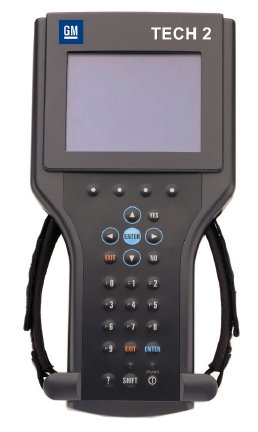
GM Tech 2

Tech 2

The Tech 2 is like a scan tool on steroids, with some additional tuning options thrown in.  As a scanning tool, the Tech 2 excels.  While an off the shelf scanner will read the Engine Diagnostic Trouble Codes (DTCs), the Tech 2 will read and report information from all the car’s systems, including ABS, Air Conditioning, Air Bags, and other systems a standard scanner will not read.  For example, in my CTS Seat experiment after the seat was replaced the Tech 2 must be used to run a Passenger Presence System relearn.  There is no other way to run this tuning step other than with the Tech 2.  Similarly some vehicle customizations or radio resets require a Tech 2 to perform.

Bosch has this informative video on the Tech 2: Bosch Tech 2 Video

Vetronix made the Tech 1.  The original GM Tech 2 was made by Hewlett Packard and used Vetronix software.  Vetronix purchased the Tech 2 manufacturing rights from HP.  In 2003, Vetronix was acquired by ETAS, a supplier of standardized development and diagnostic tools for electronic control units. In 2006, the Vetronix Aftermarket division merged with Bosch Automotive Aftermarket, responsible for supply, sales and logistics of automotive parts for service of the vehicle.  So today the Tech 2 is ‘made’ by Bosch.

The Tech 2 is used for GM Vehicles from 1992-present.  It is kept up to date by updating the 32  MB Pcmcia memory card with the latest diagnostic software.  Current cars with the CAN bus require the CANDI interface for the Tech II to communicate with the vehicle.

A Tech 2 costs — pick a number.  New models appear to cost as much as $4K, and the retail price is shown as even higher — as much as $8K or $9K depending on the site.  Discount new units are available for as low as $2300 on ebay for example, and used units run a bit less.  There appears to be a market in Chinese clones for the Tech 2 and software, although I am opposed to piracy of intellectual property.  My impression from shopping is that you should budget around $2K for an authentic Tech 2 in good condition with all accessories, 32 MB card, and CANDI module.

In the future GM appears to be moving to a laptop based scanning and diagnostic tool using the GM Multiple Diagnostic Interface (MDI) EL-47955.  The GM MDI will replace the Tech 2 for diagnostics in the future, but will not replace the Tech 2 for 1992-2009 vehicles.

The GM MDI is a compact communication module that manages the transfer of data between a vehicles onboard ECU network and a PC.  The GM MDI offers faster programming speed at a lower cost. Depending on the vehicle architecture, the MDI can be 20%-70% faster than the Tech2.  The GM MDI allows the user to perform Pass-Thru programming procedures using software running on a laptop or desktop PC.   Any PC can be used.

Re: Study Reveals Which Car Dealers Treat Customers Best

AOL Autos covers the latest JD Powers Customer Satisfaction Survey for Auto Dealer Service results here: Study Reveals Which Car Dealers Treat Customers Best.

Cadillac scored very well, coming in 4th across all auto manufacturers. (Lexus, Jaguar, BMW, Cadillac, Acura were the top 5).  The Service survey measures:

  • Overall service quality
  • How the service experience was initiated
  • The experience with the service advisor
  • The overall impression of the service facility
  • The experience picking up the vehicle from a service appointment.

This thought gives one pause:

“Toyota dealers lead the industry in sales per franchise, so that means they have a huge volume of customers to deal with at every dealership,” Osborn said. “Their survey performance tends to reflect the fact that they have service capacity issues.”

Toyota as a brand tends to rank fairly low on Customer Satisfaction with Dealer Service.  Although Toyota and Lexus are viewed as a benchmark for fewest Dealers and most sales per Dealer, which drive dealer profits, obviously those profits are not going back into customer focus and support.

GM and Cadillac have been in an ongoing push to reduce the number of Cadillac dealers across the US.  The thought is that a lower number of dealers will reduce the overhead of Dealer interface for the Factory, and raise the sales per store and result in higher dealer profits.  Higher dealer profits can then result in a better customer experience at the Dealer.  Based on Toyota’s poor dealer performance, once would have to say this is not always the case — and take this type of study as a cautionary tale of the dangers of sub-optimizing the number of Dealers.

GM often points out that Dealers are independent businesses, not under the control of GM.  I think the main question on whether a GM Dealer should remain in business is whether they are profitable or not, including perhaps a benchmark of whether they are as profitable as other dealers in similar markets.  Closing profitable locations just in the name of having fewer locations to supply seems poor practice.  Closing profitable locations on the other hand that could and should be even more profitable in the hands of different Owners seems reasonable.

One input I hear from Dealers is that no one at GM is listening to them.  Hopefully that is changing with the new management in place. The voice of the Customer should be coming in the most clearly on the sales floor and in the service bay.  The sooner Cadillac can tune in and hear from Buyers or from current Owners the better Customer Satisfaction will be.

I get the impression on vehicle launches and Dealer interface that Cadillac is stretched thin — that they don’t have the staff or management processes in place to manage the business smoothly.  Certainly ongoing changes in staff and management can make for waves.  I would be interested to see Cadillac evaluate their organization and approach in a clean sheet organizational infrastructure design approach.

Finding those small odd Cadillac parts

Ever need a small part for your Cadillac, but wonder if they even offer that part separately, or if it is part of an assembly?

Ever reach into your car to move something, and manage to break a part off in  your hand?

The nice people at CompNine.com have a solution for you.

At their site from the home page on the left under the heading “vehicles” you can click on Cadillac.  Then drill down to your year and model of Cadillac.  Finally, choose the diagram that seems to contain the part or section of the Cadillac that you are looking for.  For example, let’s look for the lean-back lever on the manual passenger seat in a 2005 Cadillac CTS base model.

Drilling down to 2005 CTS, we can see that the seats are on diagram 14.

Drilling down through the images within that section, we can see the manual seat leaver is on 2005-2007 DM,DN69 SEAT ASM/PASSENGER (EXC POWER ADJUSTER AH8)

Comp Nine Seat Lever Image

In this diagram the seat lever is marked as item #14.  In the table below the diagram we can identify item 14 as HANDLE,P/SEAT RECL(INCLS 15)(NEUTRAL)

There are actually several #14’s, one for each interior color.  The GM part number is 88897411, and clicking on that part number in the table tells me which other vehicles this part is used on.

Finally, I can see that CompNine offers this lever for sale for $44.89.

All in all these diagrams are a nice service, as they give another source of information for how the vehicles are put together, which parts are available separately as opposed to part of a larger assembly, and the approximate cost of each individual part.

CompNine has become one of my favorite reference sites.