Testing Toward MBT — New Max Torque

Today I continued my testing toward MBT by adding timing across the rev range to move the commanded advance closer to the MBT vs RPM vs Cyl Air table.  1 degree of advance was added from 3000-3600 RPM, and 0.5 degrees from 3800-6000 RPM.

The V was cold, in cool air, almost out of fuel.

I went to a less densely populated HPTuners table to gauge if that improved the data capture.  My impression is this was useful, but that we are capturing info as fast or faster than the related PID are updating anyway.  I would prefer to have the more diverse info points than oversample a smaller set for future tests.
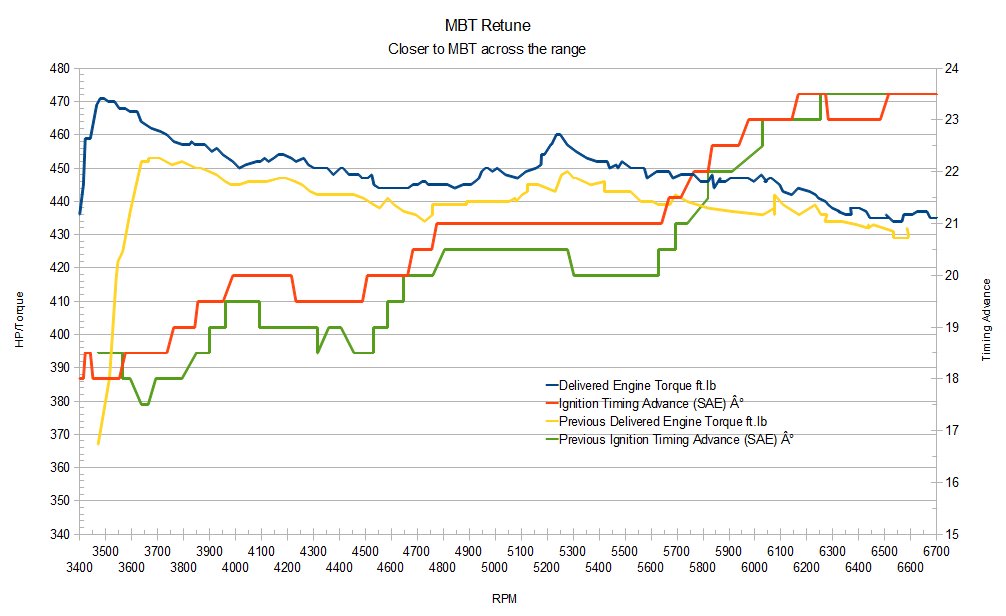
More timing makes more Torque

More timing makes more Torque

This graphic shows today’s delivered Torque in blue, and the previous delivered torque in yellow.  The current total advance in red, and previous in green.  This shows that by touching up the timing the V gained ~5 lb ft of torque throughout the range.
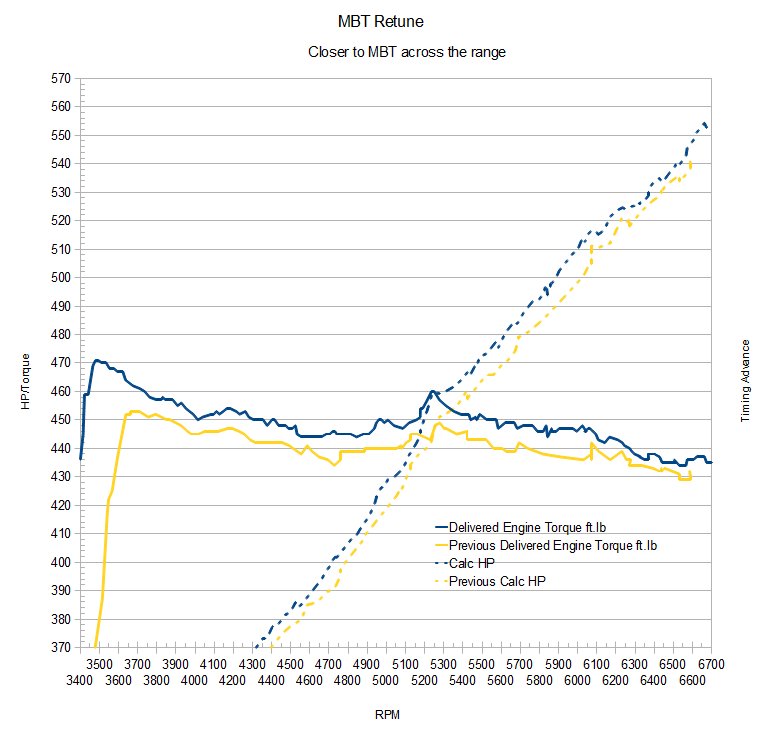
HPTuners data delivered torque & calculated hp comparison to previous

HPTuners data delivered torque & calculated hp comparison to previous

This graphic is the same info but with calculated HP compared current and previous.  The actual high points were:

Hp RPM Torque RPM
Previous 541.65 6585 453.0 3663
Current 555.78 6710 471.0 3478
Current 545.6 6573

The previous test run topped at 6585 rpm where the 2-3 shift hit; today’s run was for 545.6 hp at a similar 6573 RPM.

HP Tuners at Max Torque

HP Tuners at Max Torque

This is a hptuners snapshot at max torque point
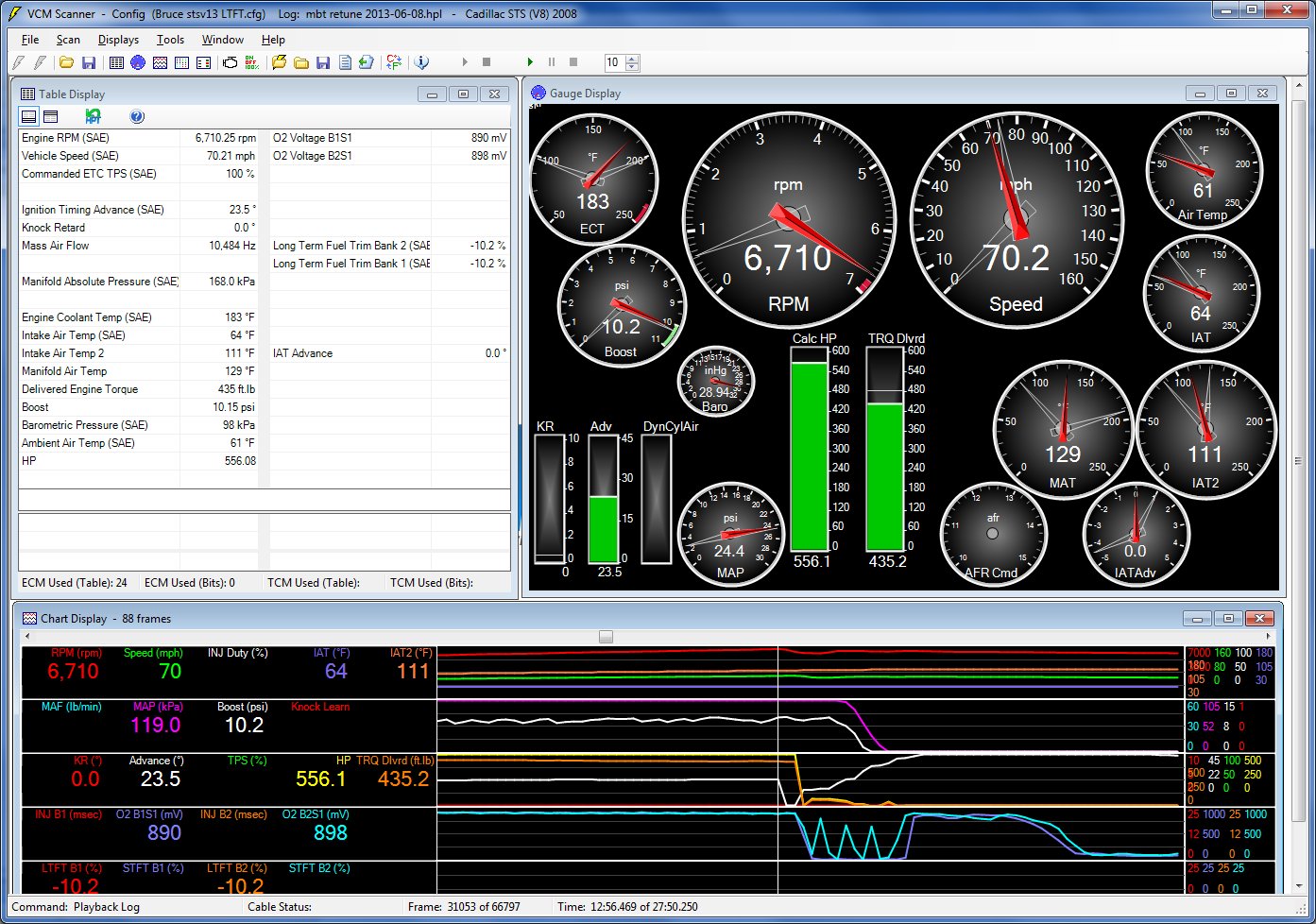
Hp Tuners at Max HP

Hp Tuners at Max HP

and here is a similar shot at max hp point.  I forgot to tell the car it was okay to shift to it redlined in 2nd for this test.

Virtual Dyno comparison of previous capture and today's run

Virtual Dyno comparison of previous capture and today’s run

The virtual dyno run shows the low torque spike but only a 386 hp peak measured.  Today’s run in red, previous odd run in blue.
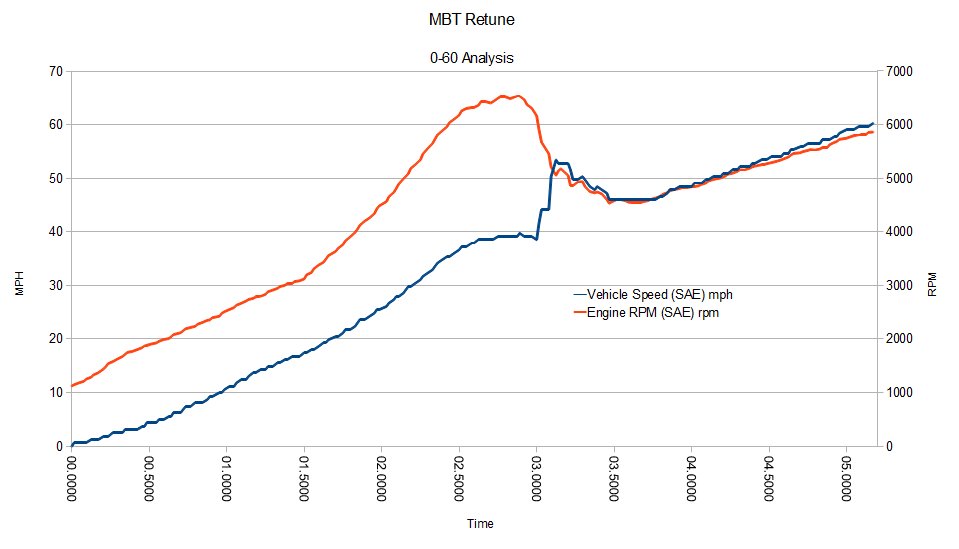
MBT retune 0-60 chart

A 0-60 run measured from the HPtuners log took 5.17 sec without rollout.  The PerformanceBox unfortunately didn’t properly capture the run so I don’t have a good figure for what it would have been with rollout.

MPH Speed
0
10 0.98
20 1.70
30 2.22
40 3.02
50 4.14
60 5.17

I really wanted to capture MAF lb/min but that was one of the things I did but should not have removed when lightening the HpTuners data table.

Summary

  • Tuning the engine across the RPM range did improve the power output as expected
  • The power gained by these slight improvements of ~5 lb ft shows that the engine is already operating close to optimal
  • Some KR is observed at 3385 RPM and 4000 RPM, suggesting that the OEM tune is close to the knock limited max torque

My conclusion is that there some gain with additional timing, but that the OEM approach is very close to optimal and provides some margin for knock / detonation.

Update:

I reduced 0.5 degrees of timing advance everywhere there was a hint of KR.  A follow-up run hot (more likely to knock) showed no KR in the tuned area.

Virtual Dyno comparison same day cold & light vs hot and heavy

Virtual Dyno comparison same day cold & light vs hot and heavy

To run the KR checks I also captured a 2nd gear test run.  Although the runs are adjusted per SAE for temp and pressure the adjustments don’t have as much impact as temps do on the STS-V.  The V runs ~22hp less power hot after adjustments, and 30+ hp missing without adjustments.

While getting my tables fixed I also found an S/C inlet pressure pid.  This sounds like pressure at the inlet of the supercharger, and is in absolute pressure.  So if we subtract this value from the barometric pressure in psi we can get vacuum at the supercharger inlet.
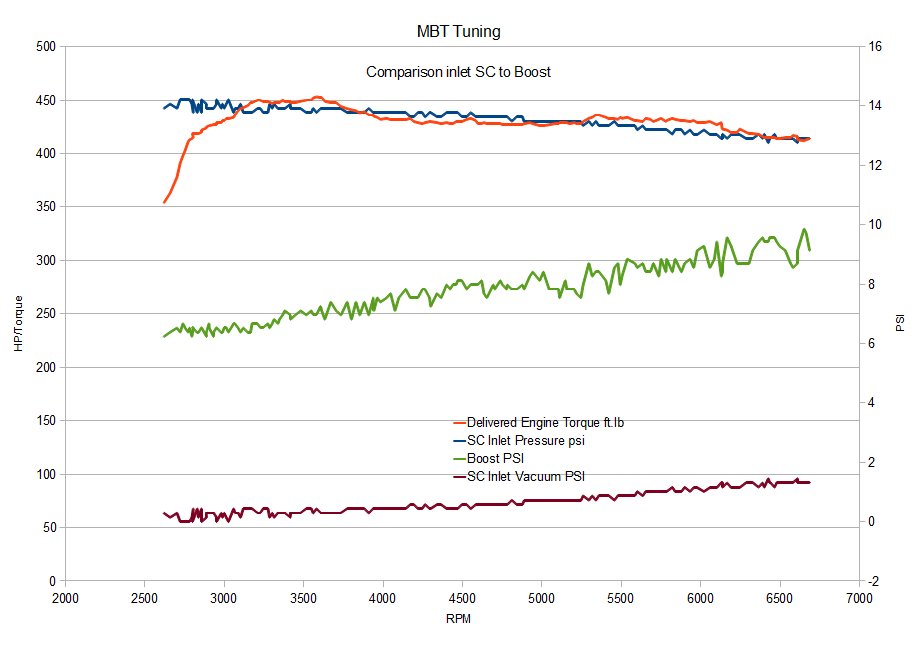
SC inlet pressure vs boost and RPM

SC inlet pressure vs boost and RPM

The SC inlet pressure goes from 0 psi at low RPM up to 1.30 psi at redline.  This figure appears to be ideal for planned air filter and intake testing.
In Pursuit of Max Torque Timing #Motorama

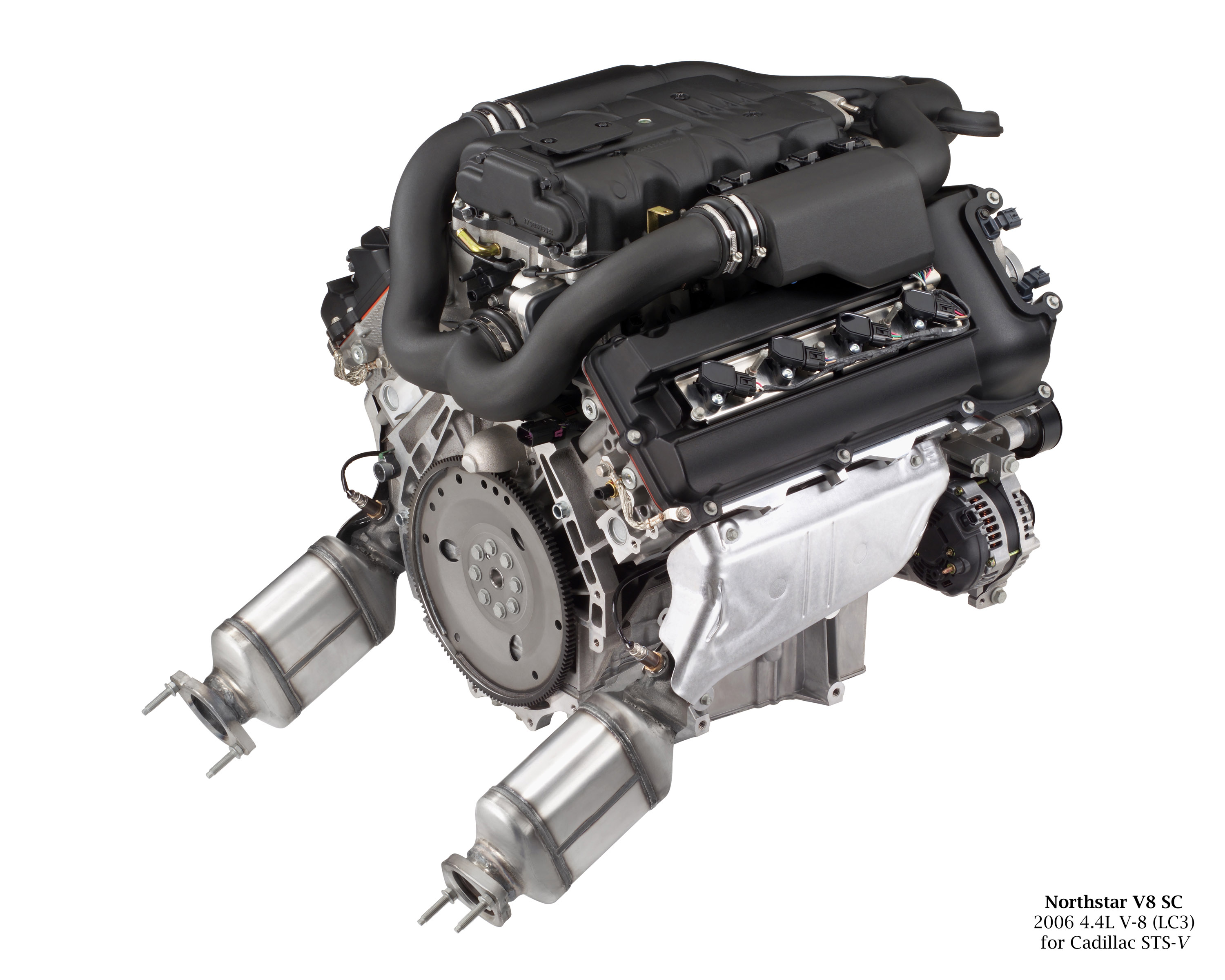
Northstar V8 SC 2006 4.4L V-8 (LC3) for Cadillac STS-V

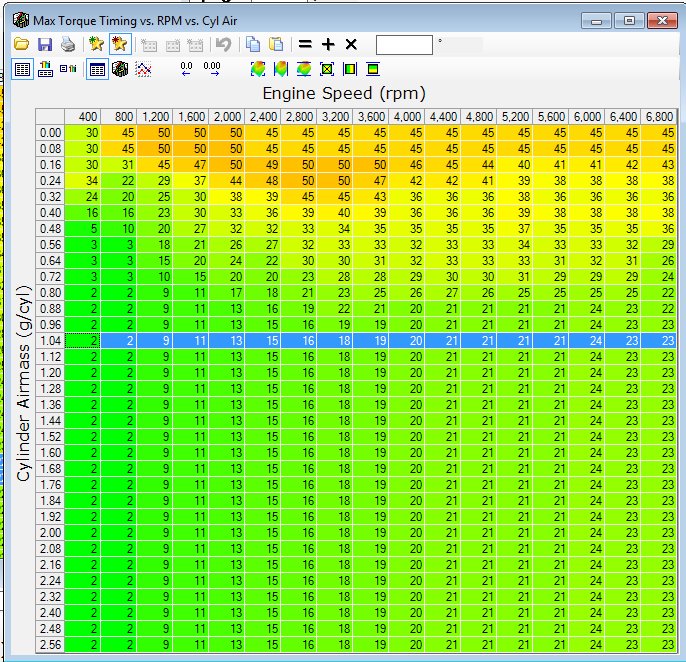
Each engine has a perfect timing advance across RPM that results in the maximum torque for that engine.  GM tucks this info into a table that HPTuners refers to as Max Torque Timing vs RPM vs Cylinder Air — the theoretical timing that provides maximum torque for the engine.

Max Torque Timeing vs RPM vs Cylinder Air

Max Torque Timing vs RPM vs Cylinder Air

The advance at various RPM points in this table may not be achievable — there could be knock or detonation at those points at this advance.  The PCM uses the table as a reference to determine delivered torque.  This is one of the few tables that HPTuners recommends the user not change.

Comparison of Actual Timing to Max Torque Timing

Comparison of Actual Timing to Max Torque Timing

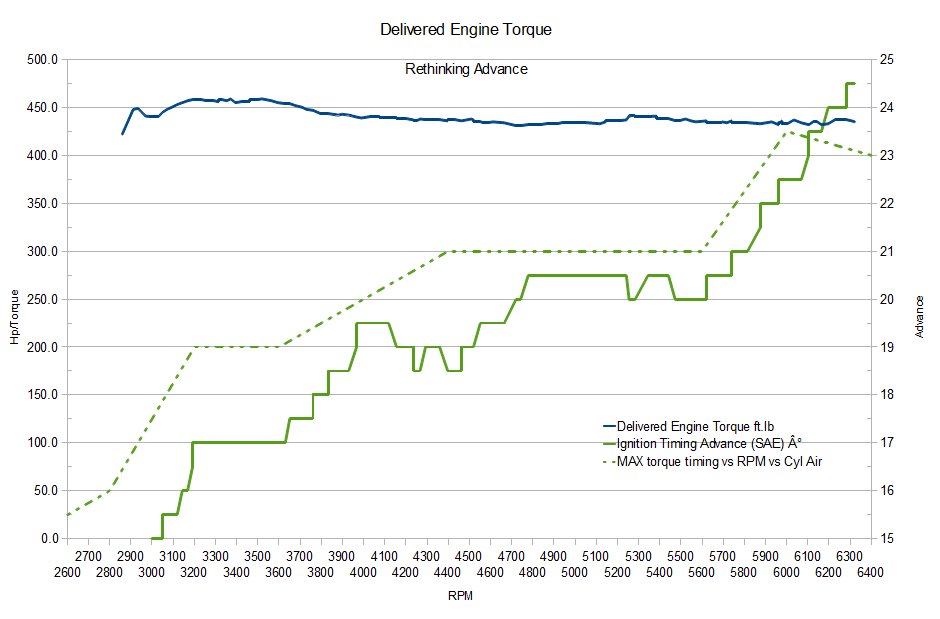
This graph shows the actual timing during a 2nd gear run in green vs the theoretical max timing in the green dashed line.  You can see that the actual timing follows along with the general shape of the maximum torque timing, although generally 0.5-2 degrees behind.

Theoretically, if I add timing to move the actual timing toward the theoretical maximum torque timing — without detonating — the STS-V will make the most power.

Now my STS-V also has an aftermarket intake, and an aftermarket exhaust.  Those change the ‘equation’ a bit.  But this is what I will be inching toward as an experiment — maximum torque timing.

Feedback

What do you think?  Have you used this table as a guide for tuning?  Or are you with the “more advance is always better” school?

Rethinking Total Timing Advance Cadillac LC3 HpTuners #Motorama

In the tuning process adjusting total timing advance on a modern engine can be tricky.  There are timing adjustments coming in from a variety of sources, which may change from one pull to another.  To simplify the dyno process, it is inviting to isolate the total timing to a single table and adjust.

The files below relate to my 2008 Cadillac STS-V with the DOHC, VVT, supercharged 4.4L V8 engine:

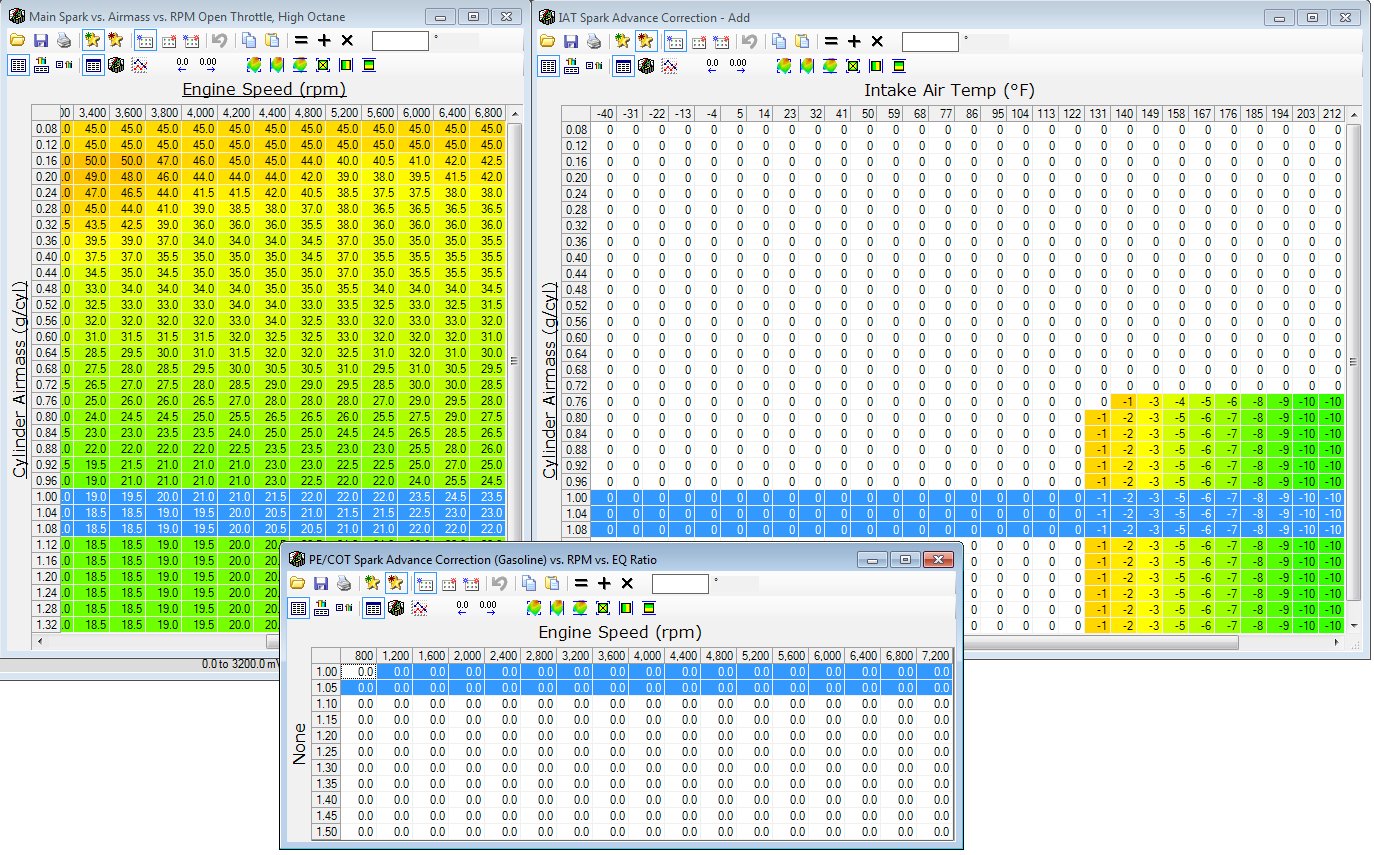
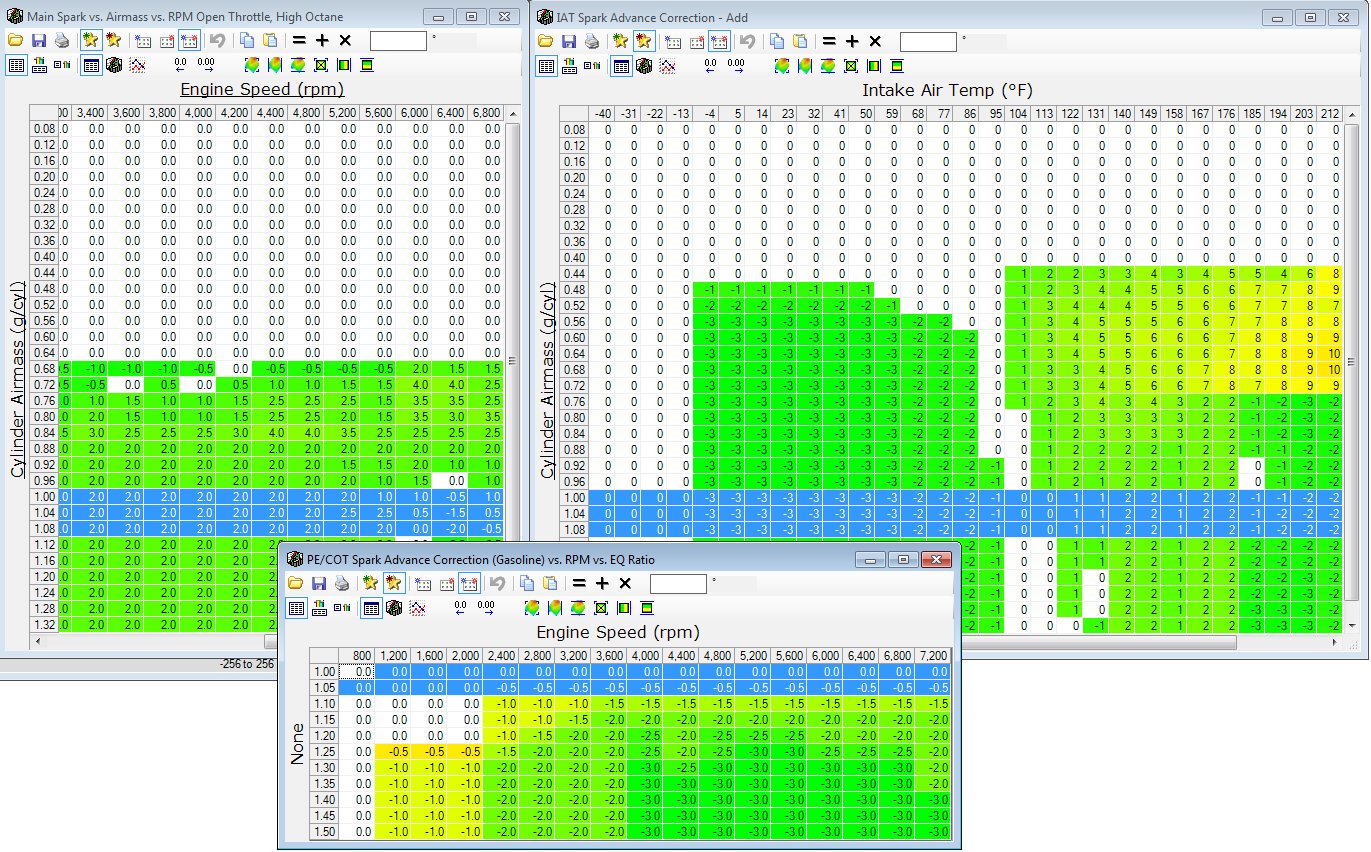
Tuned Timing -- more in the main (left) table, removed IAT timing below 122F (right), removed PE/COT timing adders (bottom)

Tuned Timing — added ~2 in the main (left) table, removed IAT timing below 122F (right), removed PE/COT timing adders (bottom)

However, holding all the timing on the main table is not ideal for how I would prefer for the engine to operate — we actually want timing from each table and adder because they offer diverse inputs for specific situations.  For example, I prefer to add timing via the intake air temperature table (IAT), which will only add timing only if the air is cool.

The image above shows an HPTuners screen shot of 3 related timing tables after tuning.

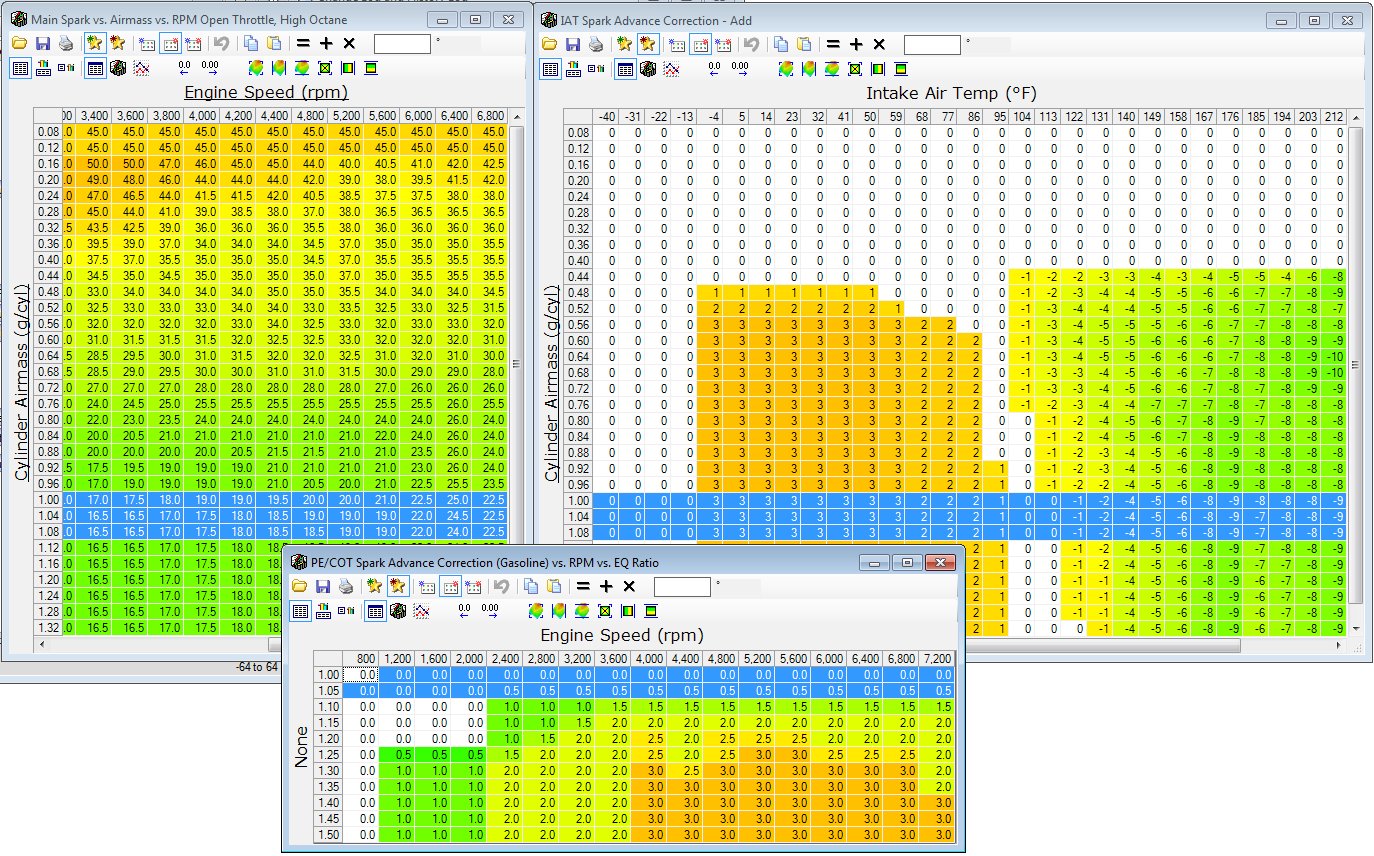
Timing for OEM calibration file

Timing for OEM calibration file

This second image shows the same tables in the OEM calibration.  In the OEM tables, the main table had slightly (2 deg) less advance, the IAT table adds advance below 95F and takes out advance above 122F, and the PE/COT table adds advance above 1.05 g/cyl.

Finally, the following table shows just delta values between these 2 tunes, or differences in the files:

Difference by comparison -- tables show just the +added timing or -removed timing for the tuned vs OEM

Difference by comparison — tables show just the +added timing or -removed timing for the tuned vs OEM

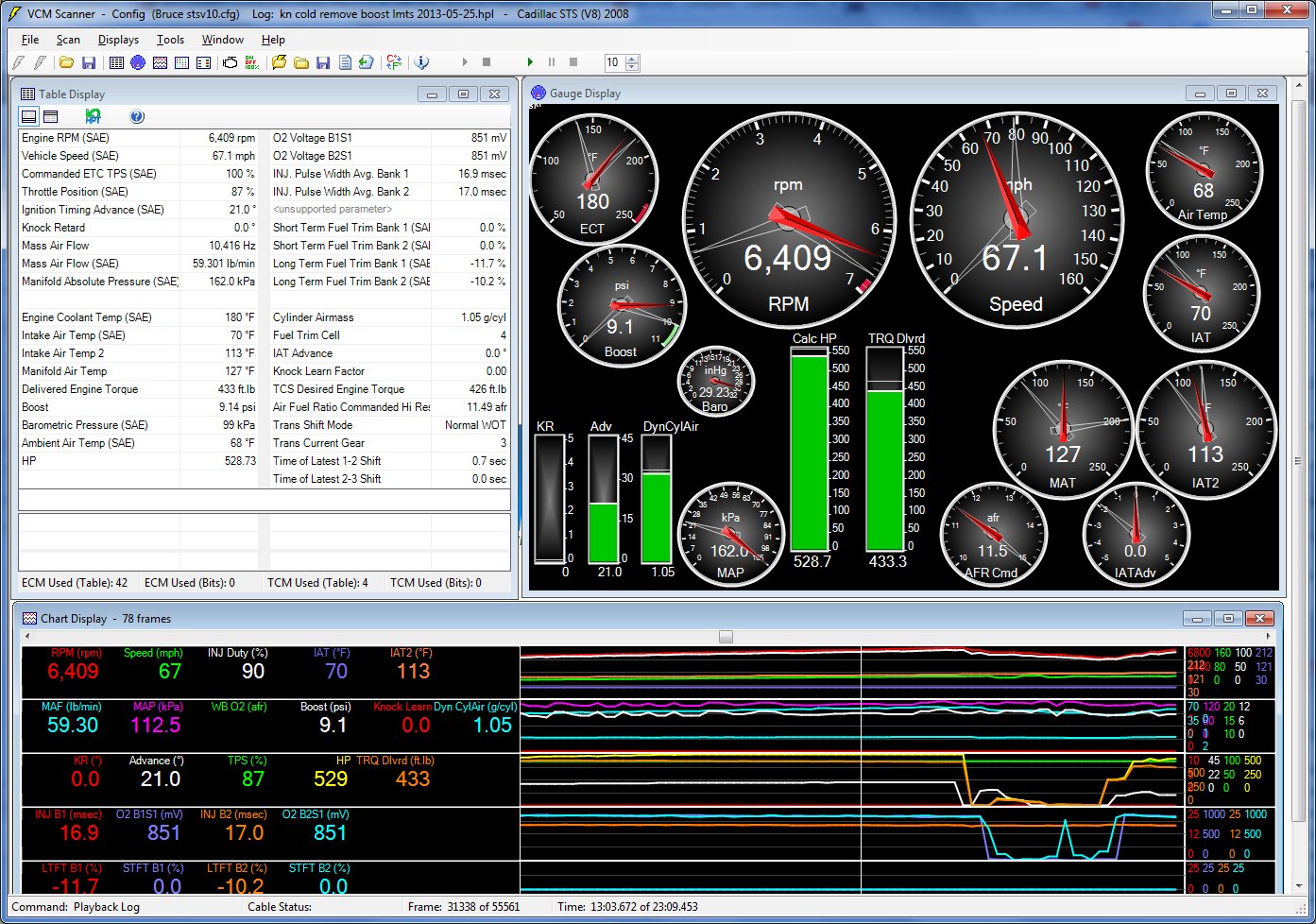
Here is the test for the ‘tuned’ timing:  we can see in scans that at 6409 RPM the STS-V is running total timing of about 21 degrees advanced at 1.05 g/cyl.

HPtuners at 6409 RPM shows 21.0 degrees total advance

HPtuners at 6409 RPM shows 21.0 degrees total advance

Looking at the Tuned tables (top ones above),

  • the main table (left) has 23 degrees at 1.04 and 22 at 1.08, so likely uses ~22.75 at 1.05 g/cyl.
  • the IAT2 was 106F on that run, so the IAT advance was 0.
  • the PE/COT table is stripped in the Tuned file, so no change there.
  • No knock retard (KR)
  • So where is our missing timing, 22.75 from these tables vs 21 degrees observed?

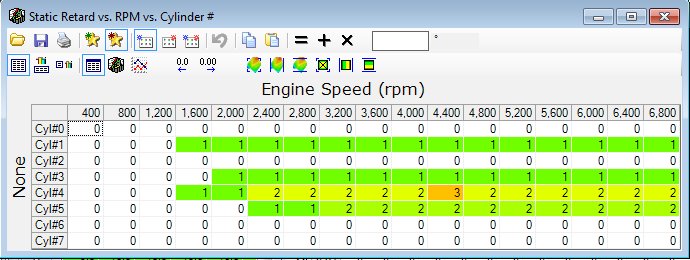
There is a static retard vs rpm vs cylinder table which is unchanged from Tuned to OEM:

Static Retard vs RPM vs Cylinder (degrees of retard)

Static Retard vs RPM vs Cylinder (degrees of retard)

which is pulling 2 degrees of retard (minus advance) from a couple of cylinders. This appears to be an as-designed adjustment to the timing by cylinder and RPM.  The SAE total advance appears to include that 0-2 degrees retard for 23 – 2 = 21 Degrees as tuned.

Going back to the OEM files, at 6400 RPM and 1.05 g/cyl we will expect:

  • Main timing table 24.4 degrees
  • IAT Table 0 degrees
  • PE/COT table 0.5 degrees
  • Static Retard  -2 degrees
  • Total advance:  24.4 main + 0 IAT + .5 PE/COT – 2 Retard = 21.9 total

So although the tuned file added +2 degrees of advance to the main table, in this circumstance the result was it reduced the timing slightly.  In colder air the tuned table had also stripped the low-temp IAT advance adds, so it would lose power there.

Next I am restoring the various advance tables to OEM calibration.  I’ll log data running the OEM advance tables.  Then I can look at adding a bit of timing via the IAT table as a way to proceed in a fail-safe manner.  I also need to recalibrate my MAF to get the LTFTs back slightly negative.

Feedback

Any advice or feedback?  Am I missing any logic or key tables in my timing thinking?

Update:

My initial run with the timing strategy adjust looks promising

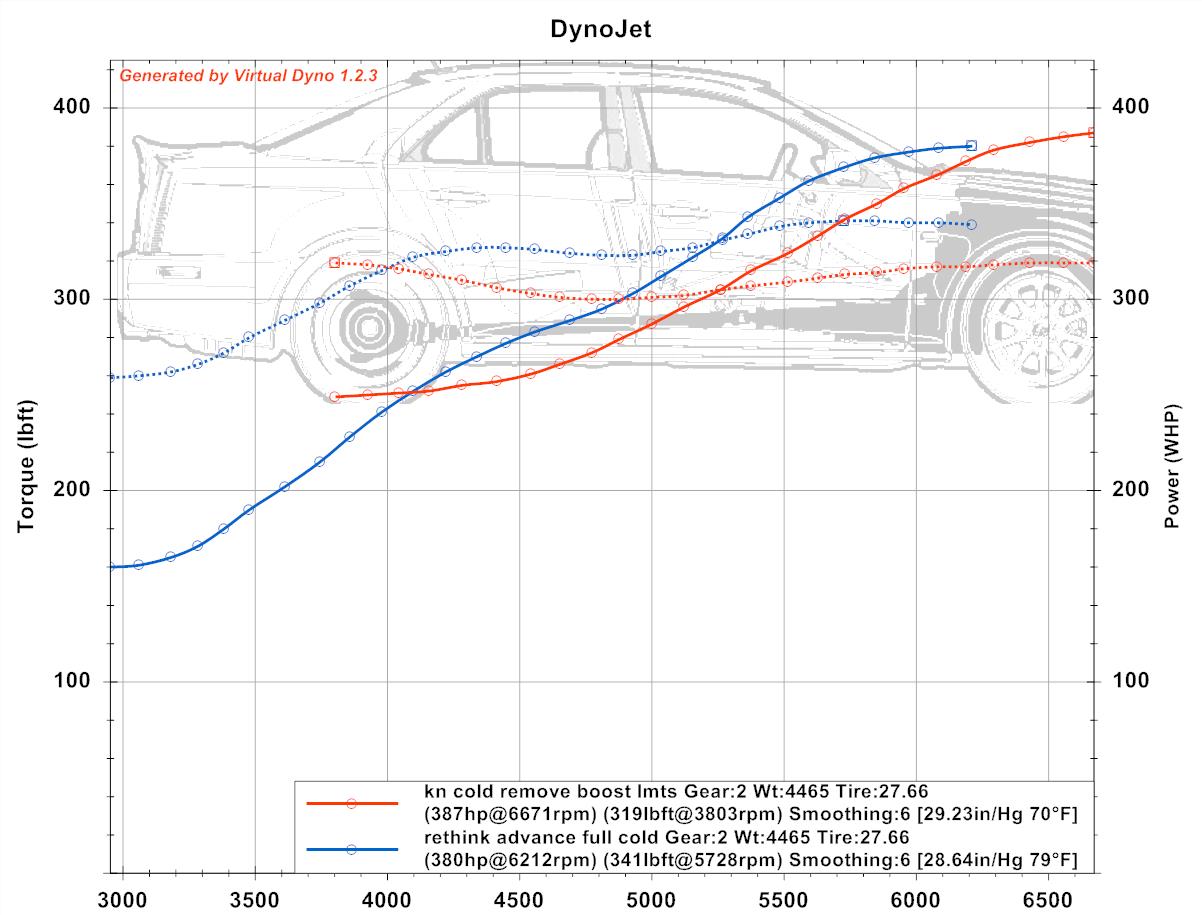
Rethink Advance comparison

What this graph shows is a comparison of today’s run (blue) with a previous tune (red), both cold (not heat soaked) and full of fuel.  Hotter day today, lower baro.  Although the peak hp was higher for the previous run in red, the today’s result is 20-25 whp above the previous for much of the run.  Today I let the transmission shift 2-3 instead of red-lining in 2, so that muted the high RPM result.

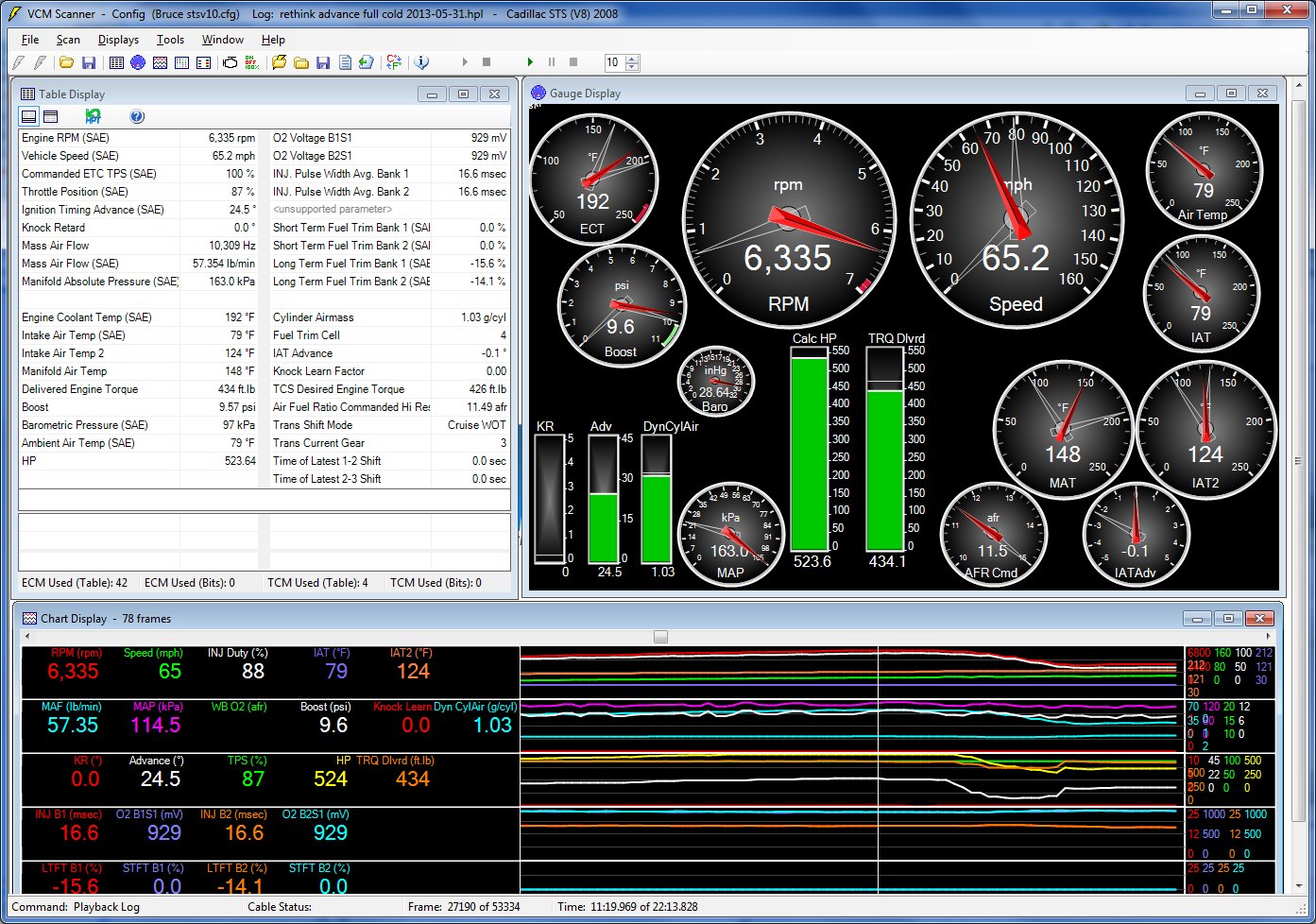
Total Timing snapshot after retuning

Total Timing snapshot after retuning

Total timing for the run ran 24.5 degrees of advance, with 0.1 IAT2 retard at that point.  I’ll have to study to see why this was more than our expected 21.9 degrees.  We were in a slightly different pressure zone — 1.03 g/sec dynamic cylinder air (57.35 MAF lb/min) vs 1.05 on the previous run / day.

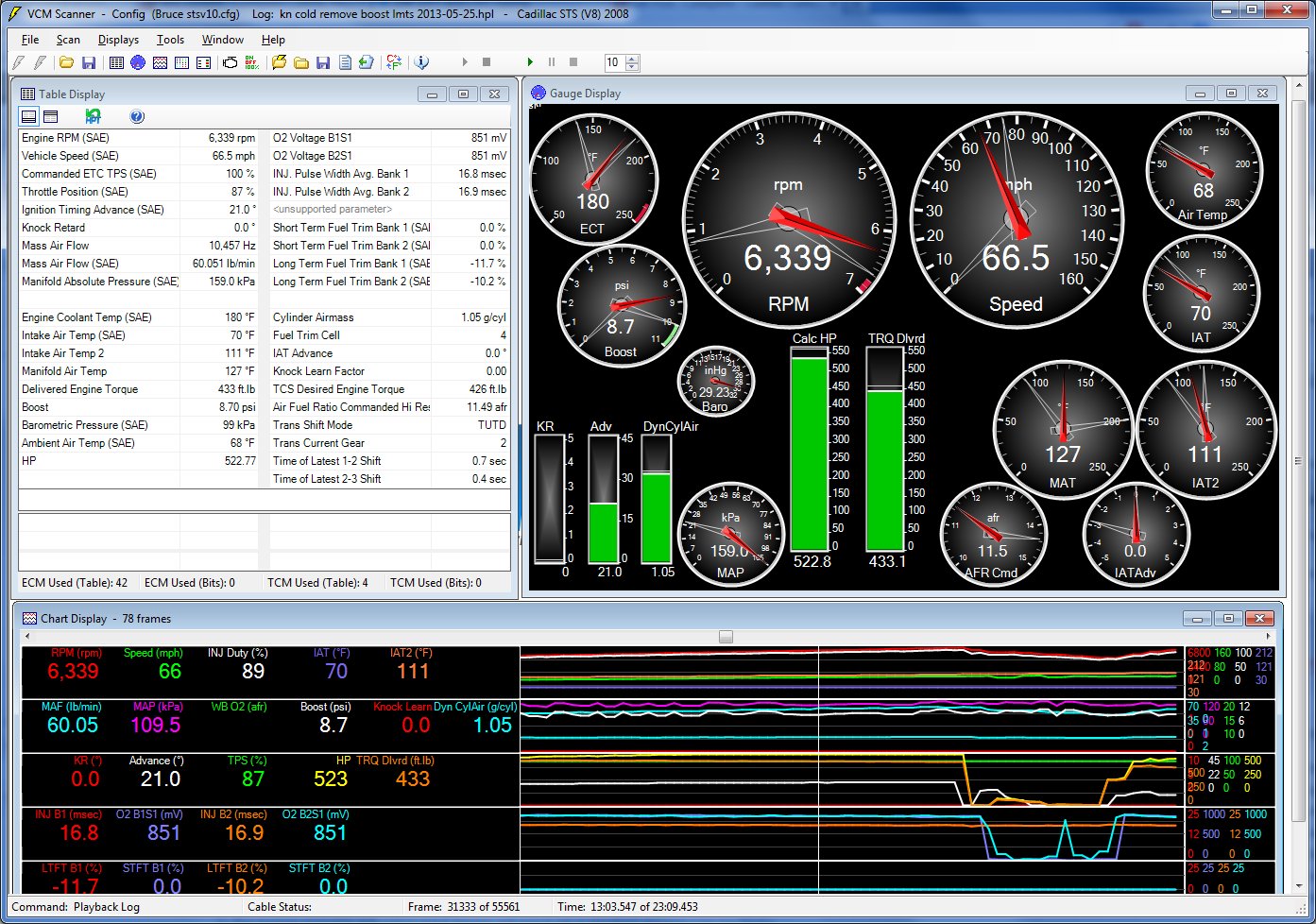
A screen capture from the previous run at a similar 6339 rpm:

Previous cold run HP Tuners display

Previous cold run HP Tuners display

Shows a comparable set of readings.

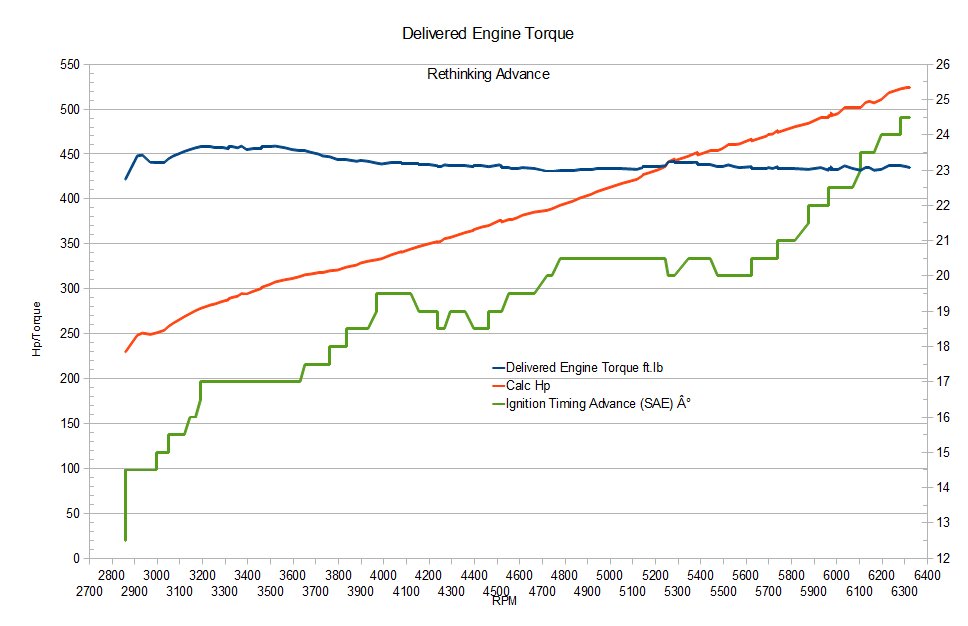
Next as an exploration I graphed delivered torque vs total ignition timing:

Delivered Torque and Calc Hp vs Total Timing

Delivered Torque and Calc Hp vs Total Timing

which shows the complexity of the total timing result across the RPM band.

Max calc values were 459 ft-lbs at 3371 and 3520 rpm, 523.6 hp at 6322 rpm (gear shift).