2010 Cadillac SRX: the Face of Cadillac

The new Cadillac SRX is currently the best selling model for Cadillac.  I have one coming for a weekend test drive and am excited to get some seat time.  Here are the  highlights of the SRX as enumerated by Cadillac:

  • All-new design targeting the heart of the luxury crossover segment
  • Front-wheel drive and available all-wheel drive with electronic limited slip differential
  • Choice of new, efficient direct injected 3.0L V-6 or optional 2.8L turbocharged V-6 engines
  • All-new chassis developed for strong driving dynamics, featuring real-time damping system
  • Comprehensive roster of connectivity, infotainment and safety technology – including Bluetooth capability and a pop-up navigation system
  • Smartly designed interior offers multiple storage options and a unique rear cargo management system
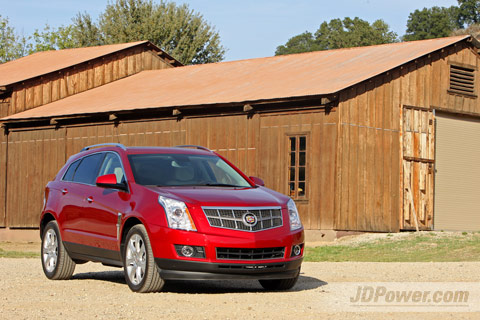
The SRX is what I think of as a mid-size SUV.  Cadillac describes it as a midsize crossover.  A crossover generally is a vehicle whose construction is unibody like a CTS, as opposed to traditional body on frame like an Escalade, but which offers the utility of an SUV.  The goal is to have the lower weight and higher efficiency while offering the utility of a SUV.  The SRX weighs more than the CTS Sport Wagon, but less than an Escalade.  This model is the 2nd generation SRX.

The SRX offers a great deal of Cadillac for a reasonable price.  It starts at $33,830, and can be optioned up all the way to $55,430 or higher.

The 3L V6 SRX is available in 4 configurations:  Standard $33,830, Luxury $37,410, Performance $41,850, or Premium $44,395.  Luxury, Performance, and Premium can also be selected in All wheel drive instead of front wheel drive.   The Turbo SRX is available only in All wheel drive, and only in Performance $49,315 or Premium for $51,860.

The new direct injected 3L engine produces 265 hp in SRX tune.  It has been criticized in the press, but I have found it enjoyable in the CTS Sedan and CTS Sport Wagon.  Because of the greater weight of the SRX it may be more challenged in this application.  It is paired with the GM Hydra-Matic 6T70 automatic. The Turbo engine puts out more peak horsepower, at 300 hp, and also will have more low-end torque.  It is paired with an Aisin AF40 6 speed automatic transmission previously used on the Cadillac BLS Diesel model.

Perhaps one key to the successful sales of the Cadillac SRX is that every configuration looks well equipped.  The Standard 3L model arrives at a very reasonable price comes with stability control, a Bose sound system, dual zone climate control, and push button start.   The steps up to or through Luxury, Performance, and Premium add incremental features.

Please stay tuned Saturday for a detailed hands-on review of the Cadillac SRX.
Luxury

The English word luxury has roots in the Latin luxus.  Luxus means ‘abundance’ or “sumptuous enjoyment”.  A luxury can be defined as an indulgence.  It can be something that is particularly elegant, or sumptuous.   Charles Hodgen has a nice article on Luxury here.

In the Latin luxuria meant sinful enjoyment.  Originally in French, Italian, and Spanish the equivalent words meant ‘lust’, and originally in Old English in the 1300s had a related meaning.

Luxury received a gradually improved meaning over the centuries according to the Online etymology dictionary.  Meaning “habit of indulgence in what is choice or costly” is from 1630s; that of “sumptuous surroundings” is from 1704; that of “something enjoyable or comfortable beyond life’s necessities” is from 1780. First used as an adjective 1930.

Today luxury means having the nicest things — the best, the most elegance, the most sumptuous.

Buyers enjoy Cadillacs because they are luxury automobiles — they offer luxury appointments, fine leather, wood grains, abundant power, smooth but capable chassis.  But don’t feel bad if your desire for a new Cadillac seems to border on lust — blame the language for not giving you the right terms to describe your emotions.

Cadillac CTS-V

Freedom of the Road

I needed to be in State College, PA to speak Monday, and to be in DC on Tuesday and Wednesday.  Now, State College PA is one of those places that  you can’t get there from Texas — not easily anyway.  There is a regional airport, but there are no direct flights from Dallas.  You normally have  your choice of flying through Detroit, or Philadelphia, or somewhere.

In this case, I knew that I needed to be in DC later in the week, so I looked at how to fly into DC, then take a commuter flight to State College.    Turned out from DC I could either take a connecting flight for 3 hours (or similar) or take a drive for 4 hours.  I of course took the drive.

Now, traffic coming out of Washington Dulles airport one would expect to be a bit congested, even on a Sunday.  But I got the navigation unit along with my Chevrolet Malibu from National Rental, and off we went.

I think the navigation unit was set for ‘maximum sightseeing, or ‘seconday roads only’, or ‘avoid tollroads’ because it led me on a merry chase past vineyards and orchards and through villages along the way.  It rained a bit, but I crossed the Potomac and the highway opened up for a while before we tucked back into the scenic route.

Given the opportunity, traveling by car was MUCH more luxurious than traveling by air.  My entire trip up to State College, no one hit the back of my seat; no one sat *way too close* to me.  There was more than plenty of room for my luggage, and no one put luggage in the storage areas near my seat because *they* brought way too much luggage.  My seat was fully adjustable for my comfort.  I had terrific leg room, and wonderful shoulder room.  I picked the entertainment on the radio.  I picked the temperature.  The ride was very quiet, with no continuous jet engine noises.  I stopped for meals or snacks along the way when I felt hungry.

Yes, I could not sleep as I traveled, but let’s face it — sleeping on a plane is a mixed bet at best.

I arrived in State College on schedule having seen and enjoyed all the scenery along the way, and having a much higher opinion of the area because I drove through the forests and vineyards and orchards and mountain passes.  I certainly recommend driving when the time difference is within an hour or two — and it often is when you include security checks and early arrivals.

You never know what you might see along the way and what adventure you miss when you fly over instead of driving through.