
6 Guns Shifting into Overdrive

The 2009 Cadillac CTS-V arrived with a supercharged 6.2L OHV V8 engine, the mighty LSA.  It also brought back an ‘expected’ Cadillac feature to the CTS-V line — an optional Automatic transmission.  But wait, what automatic transmission can be strapped to the back of a freight train like the LSA and live?  Enter the 6L90 Heavy Duty Automatic 6 speed Transmission to the world of sports cars.
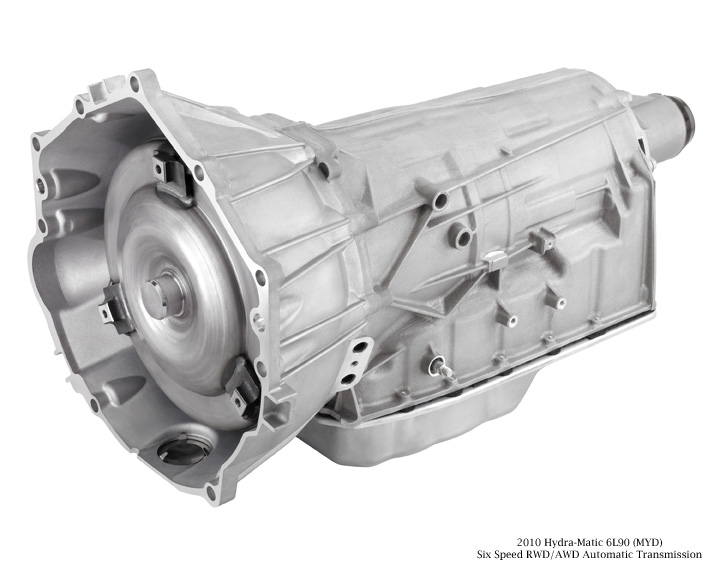
2010 Hydra-Matic 6L90 (MYD) Six Speed RWD/AWD Automatic Transmission for Cadillac CTS-V

Overview

The Hydra-Matic 6L90 is six-speed automatic transmission for rear- and four-wheel-drive trucks, designed with modular flexibility and compatibility with advanced electronic controls. It is a heavy-duty version of the 6L80 six-speed automatic, with a strengthened input gear-set which has two additional pinion gears for six total, and a strengthened output gearset, that uses wider gears than the 6L80.  The 6L90 flexibility extends to the clutches where the 6L90 has one more clutch plate than the 6L80 in each clutch for heavy duty applications.

The 6L90 has the capability for adaptive shift controls and other features such as grade braking, and Driver Shift Control with tap up/tap down shifting as found in the CTS-V. A wide overall ratio spread of 6.04:1 allows a “steep” first gear, as well as very “tall” overdrive top gear for low-rpm highway cruising. With this wide ratio spread, acceleration is maximized, as is fuel economy. Engine noise is also lower during cruising. Both fifth and sixth gears are “overdrive” gears, for example.

As in the 6L80, gear changes from second to sixth gears are accomplished with clutch-to-clutch control, where an oncoming clutch is engaged and an “offgoing” clutch is released in a precise manner to achieve the ratio change. The first-to-second up-shift, however, is a freewheeling action, where the second gear clutch engages while the first gear one-way clutch spins freely. This allows a greater degree of smoothness at lower vehicle speeds. The clutch-to-clutch shifting and single freewheeler allows significant reductions in packaging requirements.

Advances in transmission control modules allow the modules to exist reliably inside the transmission, where temperatures remain fairly constant compared to a body-mounted module. The transmission and module are assembled together, so no additional steps are necessary during vehicle assembly.

The 32-bit transmission control module (TCM) monitors transmission performance and compensates for normal wear in components such as clutch plates, so transmission performance remains consistent for the life of the transmission. The control module also “tests” the components of the transmission following assembly to optimize the interaction of the components. The module is compatible with future global applications.

2010 Hydra-Matic 6L90 Transmission ( MYD )
Type: Six speed RWD / AWD, electronically controlled automatic overdrive transmission with torque converter clutch. Clutch-to-clutch architecture, with integral Electro / Hydraulic Controls Module
Maximum engine power: 452 bhp ( 337 kW ), Diesel: 300bhp ( 223kW ) – Truck
555 bhp ( 414 kW ) – Passenger car
Maximum engine torque: 531 lb-ft ( 720 Nm ), Diesel: 520 lb-ft ( 705 Nm ) – Truck
550 lb-ft ( 746 Nm ) – Passenger car
Maximum gearbox torque: 885 lb-ft ( 1200 Nm )
Gear ratios: MYD
First: 4.03
Second: 2.36
Third: 1.53
Fourth: 1.15
Fifth: 0.85
Sixth: 0.67
Reverse: -3.06
Maximum shift speed 6200 rpm
Maximum Validated Weights: ( Target ) GVW: 15000 lb ( 6803 kg ), GCVW: 21000 lb ( 9525 kg )
7-position quadrant: P, R, N, D, X, X, X ( X = available calibratable range position )
Case description: 3-piece ( Bell, main, extension )
Case material: die cast aluminum
Shift pattern: (2) Three-way on/off solenoids
Shift quality: Five variable bleed solenoid
Torque converter clutch: Variable Bleed Solenoid ECCC
Converter size: 300mm ( reference )
Fluid type: DEXRON® VI
Fluid capacity: w/ 300mm converter 300mm: 13.0L ( 10.8kg )
Transmission weight: w/ 300mm converter Wet: 109kg ( 240lb ) estimated
Pressure taps available: line pressure
Assembly Site: GMPT Ypsilanti, MI

GMPT Toledo, OH

GMPT Silao, MX
Applications: Chevrolet Suburban H.D.
GMC Yukon XL H.D.
Chevrolet Silverado HD
GMC Sierra HD

Cadillac CTS-V

Chevrolet Express

GMC Savana
Available Control Features: Multiple Shift Patterns ( Selectable )

Driver Shift Control ( Tap Up / Tap Down )

Enhanced Performance Algorithm Shifting ( PAS )

Selectable Tow / Haul Mode

Engine Torque Management On All Shifts

Altitude and Temperature Compensation

Adaptive Shift Time

Neutral Idle

Reverse Lockout

Automatic Grade Braking
Additional Features: OBDII / EOBD

Integral Electro/Hydraulic Controls Module ( Tehcm )

Control Interface Protocol – GMLAN

So, that begs the question — was the transmission rated to fit the engine output, or is the engine tuned to that output level because that is the maximum capability of the transmission?

Cadillac CTS 1SF Performance Sedan brings Maximum Sport, Minimum cost

Cadillac offers the 2011 CTS Sedan in 3L V6 or 3.6L V6 models. For sports driving, we want the larger, more powerful 304 hp 3.6L engine.   The two 3.6L configurations are the 1SF Performance Model, and the 1SH Premium Model.  Although it is always tempting to order a Cadillac ‘with everything’, let’s look at what you get when you select all of the sport features — the performance engine, the maximum suspension — without any of the bells and whistles that reflect in the higher price of the Premium Model.

2010 Cadillac CTS

The Cadillac CTS 1SF Performance Model starts at

  • MSRP starting at: $41,565
  • Destination Freight Charge: $825
  • Colors & Options : $540
  • Total MSRP: $42,930

Now, the good news is that this includes  the Summer Tire Performance Package  with the 19″ Polished wheels with summer performance tires, HID headlamps, fog lamps, performance cooling system, sport performance suspension, limited-slip differential, and performance brakes.  The summer performance tire package also triggers the FE3 sport suspension.

What you don’t get

For true sports car appeal, these prices include the 6 speed manual transmission; the automatic is $1,300 extra.  The Recaro Sport Seats are a tempting, but they require that the Performance Luxury Package and a number of other options, including Automatic transmission be selected.   The Performance Model does not include the Navigation system, although you can add options that include it.  For weight savings stay away from the sunroof option.

Finding a car at the Dealer

When shopping for this car, focus on the 19″ wheels and the 1SF designation.  There is a RPO Y42 all-season tire Performance Package, and a RPO Y43 Summer Tire performance package; we want the Y43.  It is not clear from the guide if the Y43 forces one to go to the Automatic transmission from some reason, but if so it includes paddle shifters on the steering wheel.  Your Cadillac Dealer will be able to walk through the order system and advise.

Summary

Cadillac makes it fairly easy to home in on just the Performance options of the CTS by featuring these as a separate package.  The total price of $42,930 brings a well equipped CTS Performance Sedan for less than the starting price of a BMW 528i, the least expensive 5-series.  By focusing sharply on just the Performance options and keeping a tight reign on the urge to buy all the options, once can get a 3.6L CTS Performance Sedan for a great price out the door.

Cadillac and the V4 Escalade

The 2010 Cadillac Escalade L94 V8 engine features Active Fuel Management which allows the engine to seamlessly operate in V8 mode or in V4 mode.  All 8 cylinders are online when power is needed, and the Escalade is sport-sedan quick, able to sprint 0-60 in around 6.5 seconds.   Under the right conditions of steady state cruise, the Escalade operates on four cylinders to maximize fuel economy.

This is not a new idea, and Cadillac fans will instantly think of the V8-6-4.  The Cadillac L62 8-6-4 engine was produced in 1981 to achieve peak fuel economy while maintaining big block Cadillac family power.  In theory the engine would provide V8 power when needed, and 4-cylinder fuel economy under low load conditions.    The engine was ahead of its time, and perhaps a bit ahead of its technology.  Owners found that the mode changes unsettling, and perhaps took too long.  Cadillac tried 13 different calibrations throughout the year to find the ‘right’ mix.  Later owners report that the system works effectively, but perhaps was misunderstood in its modes of operation and responses.  Regardless, the system was only in production for a year, and only on the 368 cubic inch (6.0 L) engine.

Cadillac has not been specific about exactly how much power is available in the 2010 Cadillac Escalade V4 mode. With 403 hp on tap in V8 mode, the new Escalade L94 engine likely makes more power in V4 mode than the L62 6L made in V8 mode!

2010 Vortec 6.2L V-8 VVT (L94) for Cadillac Escalade

Details on Modern Active Fuel Management

The L94 engine features GM’s Active Fuel Management (AFM) technology. AFM temporarily de-activates four of the 6.2L engine’s cylinders under light to moderate load conditions to help enhance fuel economy by approximately 6 percent under the federal government’s required testing procedure and potentially more in certain real-world driving conditions.

Active Fuel Management stems from a simple premise: most V-8 engines offer more power than owners demand in all conditions. With AFM, drivers save fuel by using only half of the 6.2L’s cylinders during some driving conditions and reactivates them on demand when necessary.

Managed by the sophisticated E38 engine control module (ECM), AFM automatically shuts down every second cylinder, according to firing order, during light-load operation. In engineering terms, this allows the working cylinders to achieve better thermal, volumetric and mechanical efficiency by reducing heat loss, combustion loss and friction, and lowering cyclical combustion variation from cylinder to cylinder. As a result, AFM delivers better fuel economy and lower operating costs. Perhaps the most sensible aspect about AFM is that it harnesses the engine’s existing capabilities, starting with the potential designed into the E38 ECM. The only mechanical components required are special valve lifters for cylinders that are deactivated, and their control system. The incremental cost for the customer is nominal per engine. Active Fuel Management relies on three primary components: De-ac (for deactivation) or collapsible valve lifters, a Lifter Oil Manifold Assembly (LOMA), and the ECM.

One of the most sophisticated engine controllers in the industry, the E38 ECM measures load conditions based on inputs from vehicle sensors and interprets that information to mange more than 100 engine operations, from fuel injection to spark control to electronic throttle control. AFM adds an algorithm to the engine control software to manage cylinder deactivation and reactivation. When loads are light, the E38 automatically closes both intake and exhaust valves for half of the cylinders and cuts fuel delivery to those four. The valves re-open to activate all cylinders when the driver demands brisk acceleration or full torque to move a load. The engine’s electronic throttle control (ETC) is used to balance torque following cylinder deactivation or reactivation. The transition takes less than 20 milliseconds.

Valve lifters are operated by the engine’s camshaft, and lift a pushrod that operates the valves in the cylinder head. In the Gen IV 6.0L (L76), the De-Ac lifters are installed in cylinders 1, 4, 6 and 7, while the remaining cylinders use conventional lifters. The hydraulically operated De-Ac lifters have a spring-loaded locking pin actuated by oil pressure. For deactivation, hydraulic pressure dislodges the locking pin, collapsing the top portion of the lifter into the bottom and removing contact with the pushrod. The bottom of each De-Ac lifter rides up and down on the cam lobe but the top does not move the push rod. The valves do not operate and combustion in that cylinder stops. During reactivation, the oil pressure is removed, and the lifter locks at full length. The pushrods, and therefore the valves, operate normally.

The final AFM component is the LOMA. This cast-aluminum assembly is installed in the valley of the 6.2L (L94) in place of a conventional engine block cover. The LOMA holds four solenoids, control wiring and cast-in oil passages. The solenoids are managed by the ECM, and each one controls oil flow to a De-Ac Lifter, activating and de-activating the valves at one cylinder as required for Active Fuel Management.

The fuel injectors in the 6.2L (L94) are identical for all cylinders; those feeding the de-activated cylinders are simply shut down electrically by the ECM during de-activation. When the cylinders are deactivated, the engine effectively operates as a V-4. AFM operation is load based, as measured by the ECM using dozens of inputs, overlain with the driver’s demand for power as measured by throttle application. AFM’s response time varies with oil temperature, but in all cases is measured in milliseconds. Operation is always transparent to the driver. The engine returns to V-8 mode the instant the controller determines that acceleration or load requires additional power.

The benefits are substantial. Active Fuel Management does not affect exhaust emissions, and it will reduce overall emissions significantly, including greenhouse gases such as carbon-dioxide, to the extent that less fuel is used. Further, the savings reflected in EPA numbers may not account for AFM’s full impact. Owners who primarily travel long distances at steady speeds will see substantially greater fuel-economy improvements. Because of the mass differences the GMC Yukon and Cadillac Escalde models have compared to trucks and cars, the calibrations for switching to V-4 are specific and tailored to optimize efficiency.