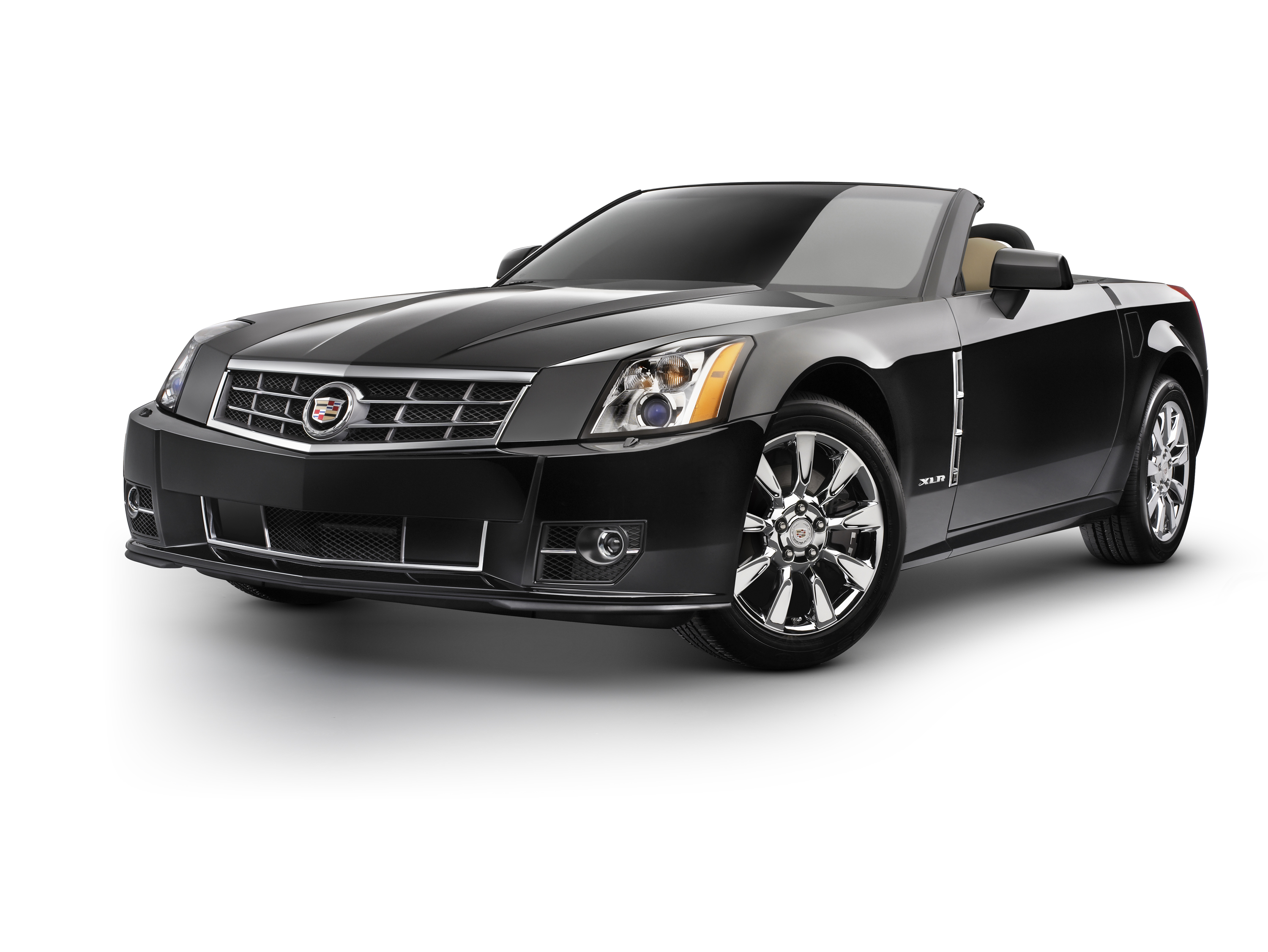
In 2004 Cadillac introduced the Cadillac XLR (Experimental Luxury Roadster). Featuring an enhanced Corvette chassis and the Cadillac Northstar Engine, the new XLR was the very first car available with the magnetic MR suspension. I covered the XLR in detail here, but I love these images of the final, 2009 XLR;
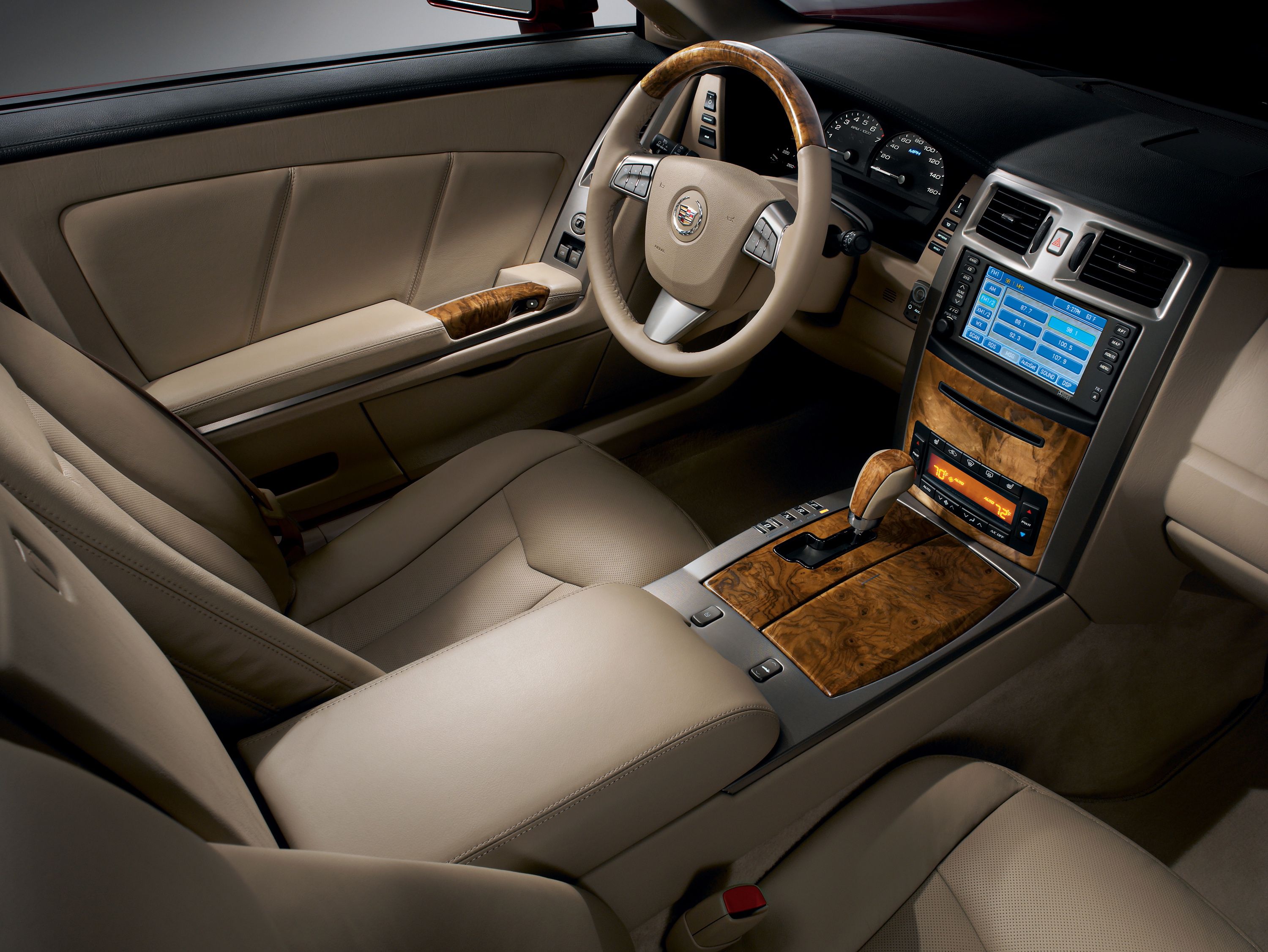
And what a luxurious interior:
It is a sort of standing joke that as soon as Automobile Manufacturers really get a model ‘right’ they cancel it. Farewell XLR.
On the other hand, welcome to interesting future used car value. With low production numbers and wonderful appointments, the Cadillac XLR will be a unique choice for years to come. Certainly not a car you will see everywhere. The V8 model with 320 hp has adequate power, and of course the V Series model is available if you need more.
Final Specifications for the 2009 Cadillac XLR:
Overview
| Model: | Cadillac XLR Platinum and XLR-V luxury roadsters |
| Body style / driveline: | XLR Platinum: 2-door hardtop convertible with rear-wheel drive XLR-V: 2-door high-performance hardtop convertible with rear-wheel drive |
| Construction: | hydroformed perimeter frame, structural center tunnel, aluminum cockpit frame |
| Manufacturing location: | Bowling Green, Ky. |
| Key competitors: | XLR Platinum: Mercedes-Benz SL500, Lexus SC 430, Jaguar Xk8 XLR-V: Mercedes Benz SL 55 AMG Roadster, Lexus SC Convertible, Jaguar XKR Convertible |
Engines
| Type: | Northstar 4.6L V-8 VVT (variable valve timing) | Northstar V-8 SC (supercharged 4.4L DOHC V-8) |
| Application: | XLR Platinum | XLR-V |
| Displacement | 279 / 4565 | 267 / 4371 |
| Bore & stroke (in / mm): | 3.66 x 3.31 / 93 x 84 | 3.58 x 3.31 / 91 x 84 |
| Block material: | cast aluminum | upper – sand-cast 319 T7 aluminum lower – die-cast aluminum |
| Cylinder head material: | cast aluminum | 319 T7 semi-permanent mold cast aluminum alloy |
| Crankshaft material: | forged steel | cast nodular iron |
| Valvetrain: | DOHC, 4 valves per cylinder, four-cam continuously variable valve timing | roller follower DOHC, 4 valves per cylinder, variable valve timing |
| Ignition system: | coil-on-plug ignition, with extended-life dual platinum-tipped spark plugs | coil-on-plug with extended-life dual platinum-tipped spark plugs |
| Fuel system: | sequential electronic fuel injection | returnless, electronic sequential fuel injection |
| Compression ratio: | 10.5:1 | 9.0:1 |
| Horsepower (hp / kW @ rpm): | 320 / 239 @ 6400 | 443 / 330 @ 6400 rpm (SAE certified)* |
| Torque (lb-ft / Nm @ rpm): | 310 / 420 @ 4400 | 414 / 561 @ 3900 rpm (SAE certified)* 90 percent of peak torque available between 2200 and 6000 rpm |
| Recommended fuel: | premium recommended but not required | premium required |
| Max. engine speed (rpm): | 6750 | 6700 |
| EPA estimated fuel economy (city / hwy): |
15 / 24 | 14 / 21 |
Transmissions
| Type: | Hydra-Matic 6L80 six-speed, electronically controlled automatic |
| Application: | XLR, XLR-V |
| Gear ratios: | |
| First: | 4.03:1 |
| Second: | 2.36 |
| Third: | 1.53 |
| Fourth: | 1.15 |
| Fifth: | 0.85 |
| Sixth: | 0.67 |
| Reverse: | 3.06 |
| Final drive: | 2.56 |
| Max. shift speed (rpm): | 6500 |
Chassis/Suspension
| Front: | short/long arm ( SLA) double wishbone, cast aluminum upper and lower control arms, transverse-mounted composite leaf spring, Magnetic Ride Control |
| Rear: | short/long arm ( SLA) double wishbone, cast aluminum upper and lower control arms, transverse-mounted composite leaf spring, Magnetic Ride Control |
| Traction control system: | full-range |
| Stabilizer bar: | front: hollow, 28.6 mm x 4.5 mm wall thickness
rear: hollow, 23.6 mm x 3.5 mm wall thickness |
| Steering ratio: | 17.2:1 |
| Steering type: | Magnasteer power-assisted rack-and-pinion |
| Steering wheel turns, lock-to-lock: | 2.9 |
| Turning circle, curb-to-curb (ft / m): | 39 / 11.9 |
Brakes
| Type: | XLR: power-assisted disc with 4-channel ABS, front and rear
XLR-V: heavy-duty with cross-drilled rotors and high-performance brake linings, dual-piston front calipers and single-piston rear calipers. Power-assist with 4-channel ABS front and rear. |
| Rotor diameter x thickness (in / mm): | XLR: front: 12.8 x 1.3 / 325 x 32; rear: 12.0 x 1.0 / 305 x 26 XLR-V: front: 13.4 x 1.3 / 340.4 x 32; rear: 13 x 1 / 330.2 x 26 |
Wheels/Tires
| Wheel size and type: | XLR: std: spun-cast painted aluminum, 18-inch x 8-inch; opt: chrome, 18-inch x 8-inch XLR-V: std: painted aluminum, 19-inch x 8.5-inch; opt: chrome, 19-inch x 8.5-inch |
| Tires: | XLR: P235/50R18 – Goodyear EMT Run Flat XLR-V: P235/45R19 – Pirelli Run Flat |
Dimensions
Exterior
| Length (in / mm): | 177.7 / 4513 |
| Width (in / mm): | 72.3 / 1836 |
| Height (in / mm): | 50.4 / 1279 |
| Wheelbase (in / mm): | 105.7 / 2685 |
| Track (in / mm): | XLR – 61.6 / 1564 (front); 62.1 / 1578 (rear) XLR-V – 62.2 / 1580 (front); 62.2 / 1580 (rear) |
Interior
| Seating capacity (front / rear): | 2 / 0 |
| Headroom (in / mm): | 37.6 / 955 |
| Legroom (in / mm): | 42.6 / 1083 |
| Shoulder room (in / mm): | 54.3 / 1380 |
| Hip room (in / mm): | 53 / 1346 |
Capacities
| Cargo volume (cu ft / L): | |
| Top up: | 11.6 / 328 |
| Top down: | 4.4 / 125 |
| Fuel tank: (gal / L): | 18 / 68.1 |
| Engine oil (qt / L): | 8 / 7.5 |
| Curb weight (lb / kg) estimated: | 3804 / 1726 |
