A tale of two Blown 4.4L V8s – BMW & @Cadillac

The new 2012 BMW M5 uses the twin-scroll, twin-turbo 4.4L V8 from the BMW X5M/X6M SUVs.  In the 2009 BMW trucks this powerplant made 547 hp, in 2010 555 hp, but in the new M5 makes 552 hp.   This all seems to need a bit more sorting.

This engine is the BMW S63, which is a twin-scroll version of the N63 V8.  For the 09 trucks it makes 547 hp at 6000 rpm and 500 lb ft of torque at 1500-5650 rpm.  As in the N63, the turbos are mounted in the V of the engine.  The engines do not appear to use the BMW valvetronic (variable valve timing used instead of a throttle), since there is a perception that it is not needed with a turbocharged vehicle, but are double Vanos systems (variable valve timing,  abbr. from German variable Nockenwellensteuerung, or variable camshaft control).
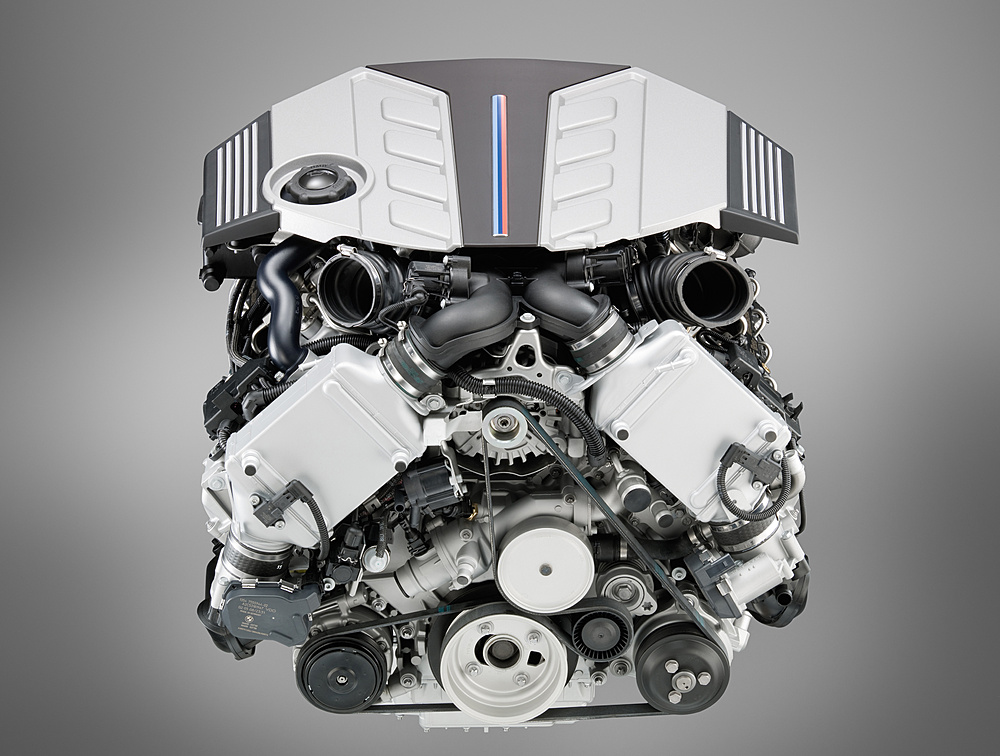
BMW S63 Engine

BMW fansites were predicting 585-600 hp for the S63 in the M5, so 552 hp is a bit of a surprise.

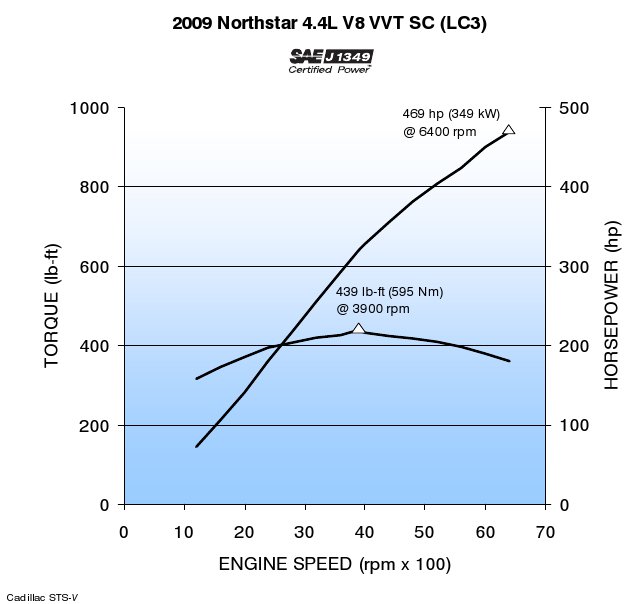
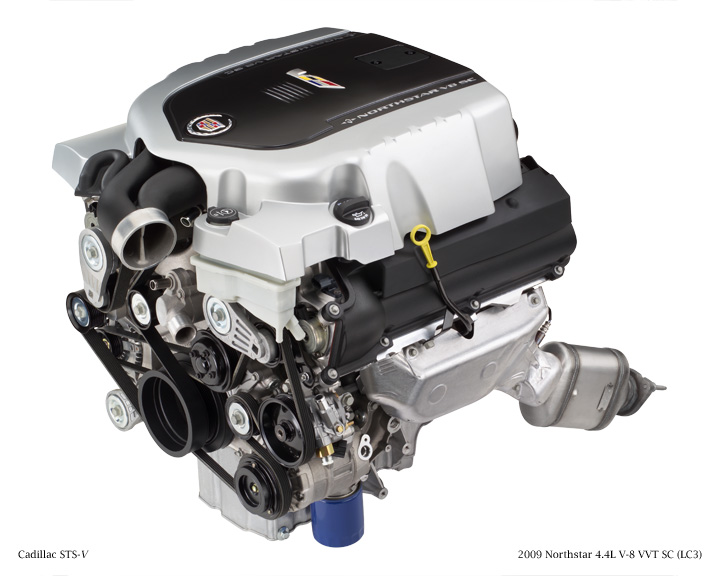
A blown 4.4L V8 seems familiar — ah yes, that’s what I have in my 2008 Cadillac STS-V!  Of course, mine is supercharged and not a turbo model as in the BMW, and makes only 469hp instead of 552 hp.  The Cadillac uses 12 psi of boost, while the BMW pushes that dial up to 22 psi of boost.  At around 4 % improvement per PSI, a LC3 running 17 psi would make similar numbers, but would run out of the boost range for the custom Eaton M122 supercharger in the Cadillac V8.  (The Stiegemeier snake bite kit does hit 17 psi however…)

[Updated] The BMW N63 makes similar boost pressure to the Cadillac LC3, at 11.6 psi but with a 10:1 compression ratio for the BMW.  The N63 was rated at 400 hp vs the 469 for the 12 psi Cadillac.  Both the N63 and S63 are direct injected engines.  The S63 uses twin-scroll turbos, cross-flow turbo plumbing, lower compression at 9.3:1, and higher boost to build to 552 hp.

The BMW SUVs have launch control, so hopefully the M5 will benefit from this as well.

A bit surprising that BMW stopped short of exceeding the Cadillac CTS-V’s 556 hp.  A shame really, as I would love to see Cadillac turn up the wick on the LSA 6.2L Supercharged V8 in the CTS-V a bit further to 600+ hp.

More on HP: Confusingly the BMW engines are still rated in PS (German: Pferdestärke = horse strength), which is a DIN standard mathematically different from British hp used in the USA.  PS has been replaced by the kilowatt, but is still used.  The 2010 BMW X5M made 414 kW, or 554 hp.  F10.5post.com is quoting the new M5 at 560PS which converts to 552 hp, but is actually less than the 563 PS in the 2010 X5 M.  Autoblog and Jalopnik are quoting the X5M at 547hp, but that was the 09 model.  I’m sure this will get sorted, hashed, and be more clear presently.

CTS-V STS-V V-Series Vanity Plates

The first rule of vanity license plates is that they are individual.  The whole point is you get to pick / specify what you want on your license plates, within a range, so that you can personalize it for your car, personality, lifestyle, etc.  So you can’t do it wrong, if you pick one you like.

A number of Cadillac V-Series — CTS-V, STS-V vanity plates tend to focus on the resemblence of the CTS-V to a 4-door Corvette, the LS2, LS6, or LSA engines in the CTS-V, or to things that rhyme with “Cad”, short for Cadillac.  Thus one might find:

  • BADCAD
  • 4DRVET
  • 4DRZR1
  • 556HP
  • LS6CAD
  • FSTCADY

All these work great, and fit the Cadillac.

When asked, I would point out that the V series are all obviously recognized as Cadillacs, so the tags need not emphasize this point.

The V-Series V stands for Velocity.  Velocity comes from the latin velocitas, swiftness, speed.  I would suggest vanity plates that play on the V:

  • VSWIFT (for very swift)
  • VRMMM
  • VQUICK
  • VFAST
  • ENVY
  • VROOM
  • VRACER

What would your favorite creative Cadillac V-Series Vanity plate say?

Project Cadillac Tuning Plan

I am enjoying my 2008 Cadillac STS-V; it is a terrific design right out of the box.   Cadillac pulled out some stops in developing this unique 4.4L Supercharged Northstar variant.  For example, the exhaust manifold was extrude honed to optimize flow.  Originally the V was rumored to get 440 hp, but with some final tuning the team was able to raise the STS-V to 469 hp.

An engine dyno as in the graph above measures horepower at the crank (hp).  A chassis dyno measures horsepower at the wheels (whp).  Horsepower at the wheels includes inefficiencies of the powertrain.

For an automatic RWD automobile, powertrain inefficiencies often run 20% of the power.  So for a 469 hp STS-V, one might expect to measure 469 x 0.8 = 375 hp at the wheels.  From my research, most STS-Vs measure 360-370 hp at the wheels, so perhaps a bit more than 20% loss at 22-24% due to luxury isolation in the powertrain. One outlier pulled 379-387 whp however.

HP is often used to indicate hp at the crank, and whp, or wheel horsepower, is used to indicate horsepower at the wheels.

To go from chassis dyno wheel hp to hp at the crank, divide by 1-inefficiency.  So if inefficiency = 20%, WHP/(1-20%) = WHP/80% = crank hp.

The classic hot rodding questions are,

  • How much money do you have?  and
  • How fast do you want to go?

The hidden gem in this discussion is, before you sink a ton of money into your car, you should have a plan.  If you want to achieve a specific goal, then you might start with a different car, for an extreme example.

Supercharged Northstar

My goals for developing my STS-V:

  • It is a Cadillac: maintain luxury features,  & avoid “noise for noise sake”
  • Test and Tune:  only add / change items which prove to add performance
  • Phase 1:  500 hp, so 400 whp
  • Phase 2: 550 hp, so 440 whp

What will that let me do?

  • Be happy that the Cadillac STS-V is tuned to optimum performance
  • Enjoy the journey of researching, selecting, testing, and writing about the Cadillac Project

My first Project looks set to be a Spectre intake from Jaime at StreetSideAuto.  In Spectre’s tests the intake added 40+ whp.  True Street Motorsports has agreed to help with testing the new intake once it arrives using their Dynojet dyno.  First we’ll establish a baseline for the STS-V stock.  Then hopefully we can get clear before/after apples to apples tests with and without each modification.

In my True Streets Motorsports correspondence they refer to the test as “Project Cadillac”, hence today’s title.

Other project ideas in sight:

  • Custom Tuning
  • Intercooler pump, reservoir or heat exchanger mods

More to come as things change, arrive, and evolve.

What would you like to see tested on a Cadillac STS-V?  If you have a performance product you would like to have independently tested on a Cadillac STS-V, please let me know.