Improving a tenth at a time…

100F out today here in Texas, but testing must go on.  Mostly because inquiring minds want to know and my interest is piqued about how this could be simpler and yet any more subtle in execution.
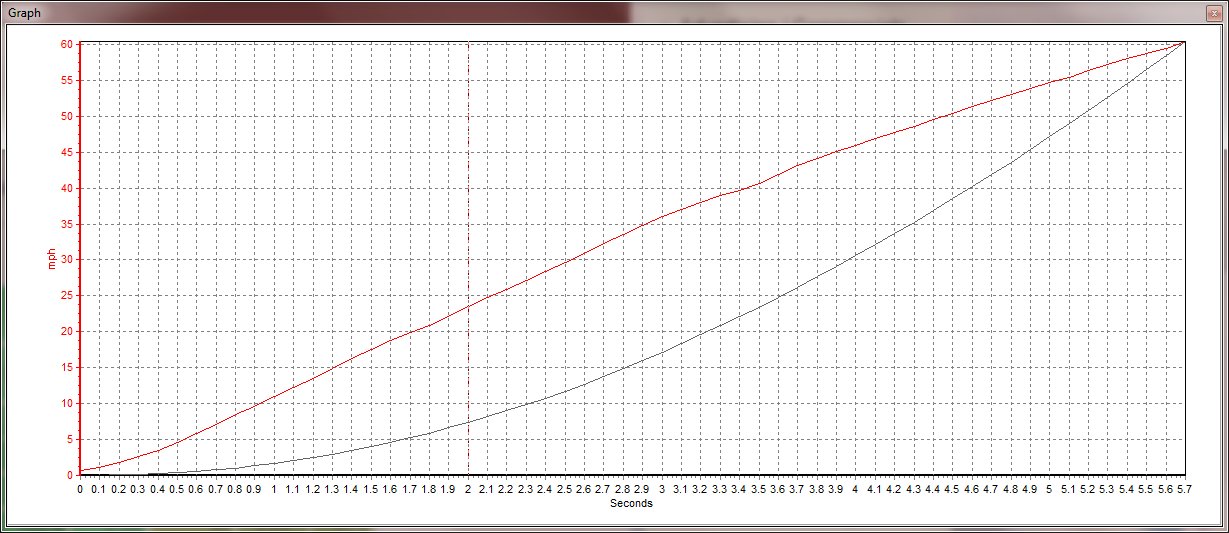
Speed vs Time (red) and Distance Travelled (gray)


And the table with comparison to last best run:

Today’s Test
Rollout Previous Test
Speed (mph) Time(s) Dist(f) 0.37 Speed (mph) Time(s) Dist(f)
10 0.93 6.33 0.56 10 0.71 7.13
20 1.71 23.73 1.34 20 1.45 23.53
30 2.53 53.59 2.16 30 2.23 51.94
40 3.43 100.4 3.06 40 3.09 96.6
50 4.45 168.07 4.08 50 4.21 170.2
60 5.66 265.64 5.29 60 5.39 265.8

Conditions: Weather: 95.6F baro 28.85 in Fuel: almost empty (car indicated 100F outside; 96F per the weather underground)

Today I wanted to try accelerating briskly until 20 mph or so then wide open throttle.  My goal was to get to 20 mph as rapidly as possible without wheelspin, figuring that even with full throttle there would be little wheel spin after 20 mph.  I was partially correct.

I also discovered that there is a cusp wherein the 6speed automatic will shift from 1 to 2 early in the low 20s if you are not at wide open throttle, which is bad for acceleration.  Manually shifting the automatic is right out because the redline at 1st comes up too fast for the manual shift to be effective.

Good news is a slightly faster best time, at 5.29 sec 0-60 with rollout.  Remember our goal is 4.9 sec 0-60 with rollout.  Low on fuel so 84 lbs lighter this run, which can also cause this difference in 0-60 times vs the earlier test.  The hotter temps act against acceleration, and 20F hotter is significant.

This simple method did improve my 1 foot acceleration time from 0.59 to 0.37 so there is that.  Also my 60′ time from a dismal 2.8 to 2.66 sec.  A reasonable 60′ time for street car on street tires is under 2.2 sec, so I am off in the first 60 ft and its me not the V.

I do think that this will be a matter of defining an exact technique to get the last few 0.1’s out however — brisk but not tire screeching acceleration up to 18-20 mph then full throttle before the transmission can decide to downshift to 2nd or similar.

In the real world it doesn’t matter much, but learning to drive the car can’t but help.

Intake update: the Spectre intakes are due from Streetsideauto.com in the next week or two, and then we’ll get before and after dyno tests run at True Street Motorsports in McKinney Texas per my  Project Cadillac Tuning Plan

Cadillac STS-V First PerformanceBox Test

I have a RaceLogic PerformanceBox which can be used to measure vehicle performance in a variety of tests.  The Performancebox is a GPS based meter and data logger.

Unfortunately, I don’t get to use it all the time, so when I do there is a short period of re-familiarization.  For my first tests, no data got written to the memory card.  After I changed the setup to “yes, please write data” things improved dramatically.

Here was the best run written to the card today:

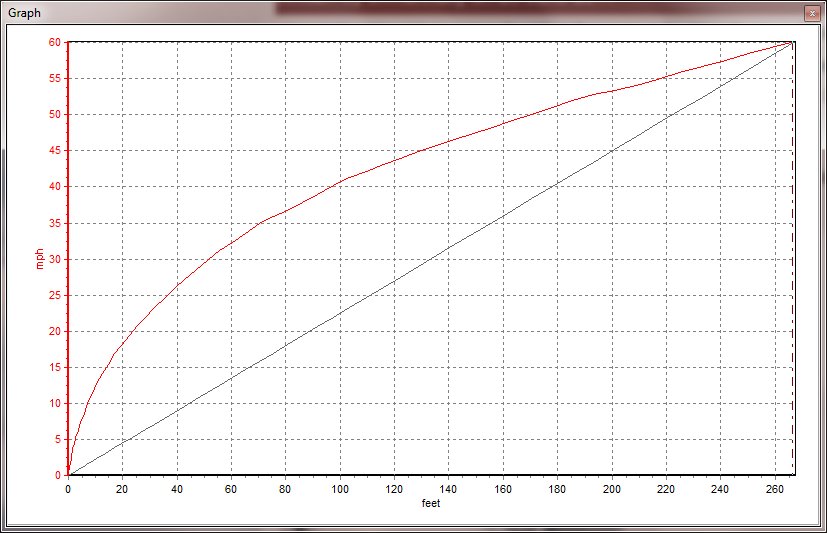
MPH vs Distance shows challenge getting off the line


Accel results
Speed(mph)     Time(s)
0-60                   05.4

With 1 ft roll-out details:

Speed(mph) Time(s) Dist(f)
0 0.00 0
10 0.71 7.13
20 1.45 23.53
30 2.23 51.94
40 3.09 96.6
50 4.21 170.2
60 5.39 265.8

Roll-out is a determination for ‘when’ the test time begins.  At a drag strip, there is up to 1 foot of roll-out before the timing lights are tripped, hence the term.  In other words, due to surface quality and wheel-spin it took me 0.59 sec to get 1 foot forward, but at the track that time would not have been included in the results and is not included above.

Weather Conditions: 87F; barometric pressure 29.69 in; humidity 64%.  Fuel: Full

Not sparkling time for the Cadillac STS-V, which Cadillac measured at 4.9 sec 0-60 mph with roll-out.  Most magazine tests ran high 4.x to low 5.x sec.  Road & Track measured 4.7 sec 0-60 mph for the STS-V.

I feel the 2008 STS-V is capable of a better time.  Getting the STS-V off the line involves a great threat of wheel-spin to be avoided.  Of course, my test area is not a sticky well prepared launch spot like at the drag-strip, but it does closely model real world circumstances.

On the bright side, this is a new ‘best’ for my personal vehicle measurements; my previous best was 0-60 in 5.95 sec in my modified CTS 3.6L and was measured on the AP-22 meter in more favorable circumstances.

Stock
STS-V


Mod CTS 3.6L
Speed (mph) Time(s) Dist(f) Time(s) Dist(f)
10 0.71 7.13 0.68 4
20 1.45 23.53 1.40 21
30 2.23 51.94 2.33 55
40 3.09 96.6 3.31 105
50 4.21 170.2 4.55 187
60 5.39 265.8 5.95 301

A line by line comparison — albeit of apples and oranges since different days, different gadgets — echoes the same issue — get the STS-V off the line faster and it would have much better times, and at 60 mph is 35 feet ahead of the CTS.

T is for Texas STS-V @Cadillac


I have been having to travel a lot lately, so the Wife’s Chihuahua Arnold is not getting to go on as many walks, rides, fun stuff as he would prefer. So when I am home, he is available in case I do anything mildly interesting.

For Father’s Day this year I asked for vanity plates for the new-to-me 2008 Cadillac STS-V.    I picked them up today, and ran out tonight to a) take the dog for a fun Cadillac ride and b) grab a snap.  Arnold decided he NEEDED to be in the picture, so here it is with him in the foreground.

You order them online in Texas, then the Registration office emails when they are in, and updates your registration sticker to reflect the new tags.

Love the new plates.  They look odd enough that they don’t look like real license plates, but they match the Cadillac well and I am happy with the result.